Summarise blog with AI


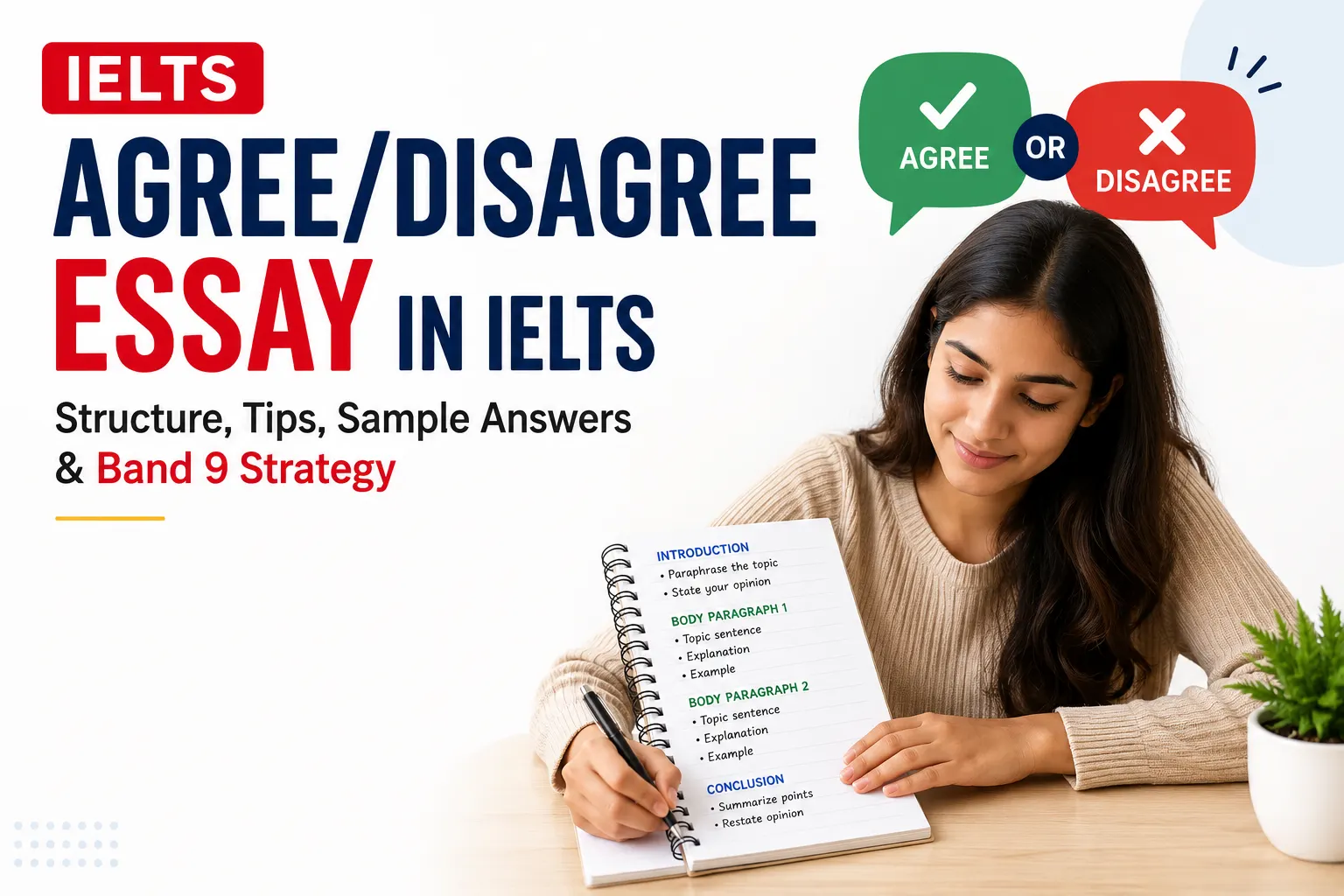
Agree/Disagree Essay in IELTS: Structure, Tips, Sample Answers & Band 9 Strategy
- 8 min read

Last updated on 13 May 2026
Summarise blog with AI
The Agree/Disagree Essay is one of the most repeated question types in IELTS Writing Task 2. Many test takers preparing with IELTS mock tests find it tricky because they are not sure whether to discuss both sides or only one side.
In this type of essay, you must:
Imagine you are having a debate with a friend about a topic, and you need to convince them that your opinion is the best. That is basically what an IELTS agree/disagree essay is all about!
An Agree Disagree Essay asks you to give your opinion about a statement.
As such, the requirement is simple and straightforward.
Your essay in IELTS is evaluated on four distinct criteria:
All four areas of evaluation are equally important.
You completely agree with the given statement.
Example: “I strongly agree that technology improves education.”
You completely disagree with the statement.
Example: “I completely disagree that social media is harmful.”
You agree with some parts but not all.
Example: “I partly agree that online learning is effective, but it has its limitations.”
Note: Choose your position carefully, and stay consistent.
Example:
Some people argue that university education should be free. I completely disagree with the statement. Such a system is likely to place a financial burden on the government’s budget. Moreover, removing tuition fees may decrease motivation among students, whereas financial investment keeps them committed to academic success.
Example:
One significant reason why I disagree with free university education is that it places a huge stress on a government's budget. To provide tuition-free degrees for everyone, the government needs massive funds, which can lead to shortages in other important sectors. Money used for universities might be taken away from public healthcare services or infrastructure like roads and bridges. For instance, the free university education policy in Sri Lanka has placed a heavy financial burden on its government, leading to reduced expenditure in many other sectors. Such a practice can negatively affect a nation's overall economy and the daily lives of its people. Practicing similar topics through an IELTS practice test can help students develop stronger ideas and arguments for IELTS Writing Task 2 essays.
Example:
Another reason is that students may not value education if it is free. When people pay nothing for a service, they often do not take it seriously. For instance, some students might skip classes, neglect their assignments, or perform poorly because they do not feel a personal financial responsibility for their degree. In contrast, paying tuition can be a powerful motivator, encouraging students to work harder and finish their studies on time. Without this financial investment, there may be a lack of accountability and academic effort among students, which is also a loss for the state.
Example:
In conclusion, I disagree with tuition-free university education, as it creates financial strain on governments and decreases student motivation. Therefore, countries should implement awards or scholarships for students to balance access to education with economic stability.
Topic:
Some people think that students should study only subjects they like. Do you agree or disagree?
Sample Band 9 Answer:
Many people believe that students should concentrate only on the subjects they enjoy. They probably believe that this motivates students to achieve more academic success. However, I strongly disagree with this opinion, as studying a wide range of subjects is essential for a student’s overall growth and future success.
The main reason why I believe so is that different academic disciplines help students develop a variety of important skills. For instance, subjects such as science and mathematics develop logical thinking and problem-solving abilities, whereas literature and the arts encourage imagination and creativity. If learners focus solely on subjects they like, they may fail to build a balance of vital skills in life, which is increasingly necessary in today’s competitive and complex world. As a result, their future academic and professional opportunities could become limited.
Moreover, young students often lack a clear understanding of their true interests and strengths. At an early stage in life, interests are still developing, and studying multiple subjects allows students to discover different areas of knowledge. This discovery can help them identify hidden talents or passions they were previously unaware of. For example, a student who initially finds mathematics difficult may, over time, develop an interest in it and later pursue a career in fields such as engineering or economics.
In conclusion, while it is natural for students to have personal preferences, focusing only on enjoyable subjects is not a wise practice. A broad education not only provides learners with diverse skills, but also helps them identify their true potential. Therefore, rather than allowing them to study only what they prefer, students should be encouraged to study a variety of subjects.
Why This Essay Scores High:
1. Read the question carefully to understand it completely
2. Brainstorm ideas (take 4-5 minutes)
3. Choose your position (agree/disagree)
4. Organize paragraphs according to topic ideas
5. Proofread for grammar, vocabulary, and spelling
Spending 4-5 minutes on planning is one of the most crucial requirements for a high-band essay.
Most students lose marks because of the following reasons:
Opinion Phrases:
Linking Words:
Academic words:
Practice using simple but correct vocabulary for a high band score.
Try these topics to build confidence with this essay type:
Note: Clarity of ideas is more important than complex vocabulary.
Also Read: How to Apply for IELTS Exam in 2026: Easy Step-by-Step Process
In this type of essay, you must:
- Take a clear position (agree or disagree)
- Support your opinion with reasons
- Use examples to explain your ideas
What is an Agree/Disagree Essay in IELTS Writing Task 2?
Imagine you are having a debate with a friend about a topic, and you need to convince them that your opinion is the best. That is basically what an IELTS agree/disagree essay is all about!
An Agree Disagree Essay asks you to give your opinion about a statement.
Common Question Formats:
- Do you agree or disagree?
- To what extent do you agree with the given statement?
What Examiners Expect:
- A clear opinion/position throughout the essay
- Logical paragraphing
- Strong explanations
- Supporting examples
As such, the requirement is simple and straightforward.
IELTS Band Descriptors for Agree/Disagree Essays
Your essay in IELTS is evaluated on four distinct criteria:
Task Response
- Did you answer the question clearly?
- Did you give your opinion?
Coherence and Cohesion
- Is your essay well-organized?
- Did ideas connect smoothly?
Lexical Resource
- Did you use the words in the right contexts?
- Did you avoid an excessive repetition of words?
Grammar
- Are your sentences correct and clear?
- Did you use punctuation marks and capitalization accurately?
All four areas of evaluation are equally important.
Types of Agree/Disagree Essay in IELTS
1. Fully Agree Essay
You completely agree with the given statement.
Example: “I strongly agree that technology improves education.”
2. Fully Disagree Essay
You completely disagree with the statement.
Example: “I completely disagree that social media is harmful.”
3. Partially Agree Essay
You agree with some parts but not all.
Example: “I partly agree that online learning is effective, but it has its limitations.”
Note: Choose your position carefully, and stay consistent.
Step-by-Step Structure for IELTS Agree/Disagree Essay
Introduction
- Introduce the topic (1-2 sentences)
- State your opinion
- Thesis statement (a brief summary of your main points)
Example:
Some people argue that university education should be free. I completely disagree with the statement. Such a system is likely to place a financial burden on the government’s budget. Moreover, removing tuition fees may decrease motivation among students, whereas financial investment keeps them committed to academic success.
Body Paragraph 1
- Topic sentence (main idea)
- Explanation (why you think this way)
- Example (to support your point)
Example:
One significant reason why I disagree with free university education is that it places a huge stress on a government's budget. To provide tuition-free degrees for everyone, the government needs massive funds, which can lead to shortages in other important sectors. Money used for universities might be taken away from public healthcare services or infrastructure like roads and bridges. For instance, the free university education policy in Sri Lanka has placed a heavy financial burden on its government, leading to reduced expenditure in many other sectors. Such a practice can negatively affect a nation's overall economy and the daily lives of its people. Practicing similar topics through an IELTS practice test can help students develop stronger ideas and arguments for IELTS Writing Task 2 essays.
Body Paragraph 2
- Second reason (Topic sentence)
- Explanation (why you think this way)
- Example (to support your point)
Example:
Another reason is that students may not value education if it is free. When people pay nothing for a service, they often do not take it seriously. For instance, some students might skip classes, neglect their assignments, or perform poorly because they do not feel a personal financial responsibility for their degree. In contrast, paying tuition can be a powerful motivator, encouraging students to work harder and finish their studies on time. Without this financial investment, there may be a lack of accountability and academic effort among students, which is also a loss for the state.
Conclusion
- Restate your opinion or thesis statement
- Summarize the ideas
- Add something new (suggestion or prediction)
Example:
In conclusion, I disagree with tuition-free university education, as it creates financial strain on governments and decreases student motivation. Therefore, countries should implement awards or scholarships for students to balance access to education with economic stability.
Band 9 Sample of Agree/Disagree Essay
Topic:
Some people think that students should study only subjects they like. Do you agree or disagree?
Sample Band 9 Answer:
Many people believe that students should concentrate only on the subjects they enjoy. They probably believe that this motivates students to achieve more academic success. However, I strongly disagree with this opinion, as studying a wide range of subjects is essential for a student’s overall growth and future success.
The main reason why I believe so is that different academic disciplines help students develop a variety of important skills. For instance, subjects such as science and mathematics develop logical thinking and problem-solving abilities, whereas literature and the arts encourage imagination and creativity. If learners focus solely on subjects they like, they may fail to build a balance of vital skills in life, which is increasingly necessary in today’s competitive and complex world. As a result, their future academic and professional opportunities could become limited.
Moreover, young students often lack a clear understanding of their true interests and strengths. At an early stage in life, interests are still developing, and studying multiple subjects allows students to discover different areas of knowledge. This discovery can help them identify hidden talents or passions they were previously unaware of. For example, a student who initially finds mathematics difficult may, over time, develop an interest in it and later pursue a career in fields such as engineering or economics.
In conclusion, while it is natural for students to have personal preferences, focusing only on enjoyable subjects is not a wise practice. A broad education not only provides learners with diverse skills, but also helps them identify their true potential. Therefore, rather than allowing them to study only what they prefer, students should be encouraged to study a variety of subjects.
Why This Essay Scores High:
- There is a clear opinion
- It has strong structure and paraphrasing
- It contains relevant examples
- It has easy-to-understand vocabulary
How to Write an Agree/Disagree Essay
1. Read the question carefully to understand it completely
2. Brainstorm ideas (take 4-5 minutes)
3. Choose your position (agree/disagree)
4. Organize paragraphs according to topic ideas
5. Proofread for grammar, vocabulary, and spelling
Spending 4-5 minutes on planning is one of the most crucial requirements for a high-band essay.
Common Mistakes to Avoid:
Most students lose marks because of the following reasons:
- No clear opinion: Always state your opinion clearly.
- Mixing viewpoints: Changing or adding a new opinion in the middle ruins the structure of the essay.
- Weak examples: Always support ideas with examples, no matter how simple.
- Poor structure: Follow proper paragraphing format.
Vocabulary for Agree/Disagree Essay
Opinion Phrases:
- I agree that ….
- I disagree with the view that ….
- In my opinion ….
- My view is that ….
Linking Words:
- Firstly
- However
- In addition
- Therefore
Academic words:
- Benefit
- Drawback
- Impact
- Development
Practice using simple but correct vocabulary for a high band score.
Practice Questions
Try these topics to build confidence with this essay type:
- Do you agree or disagree that online education is better than classroom learning?
- Do you agree that technology makes life easier?
- Do you agree that parents of obese children should be penalized?
- Do you agree or disagree that social media is harmful?
Expert Tips to Score Band 7+
- Keep your opinion clear and stick to it
- Use simple and meaningful language
- Give strong examples to back up your explanation
- Avoid memorized answers
Note: Clarity of ideas is more important than complex vocabulary.
Also Read: How to Apply for IELTS Exam in 2026: Easy Step-by-Step Process
FAQs
Can I Partially Agree?
Yes, but your position must be clear throughout the essay.
How Many Words Should I Write?
You should write at least 250 words for IELTS Writing Task 2. However, there is no official upper word limit.
Do I Need Examples?
Yes. Examples help explain your ideas clearly and make your arguments stronger.
Can I Write Equally About Both Sides?
No. You should focus mainly on your own opinion and support it consistently throughout the essay.
How Can I Master IELTS Agree/Disagree Essays?
The Agree/Disagree essay becomes easier when you follow the correct strategy:
- Take a clear position
- Explain your ideas in detail
- Use relevant examples
- Organize paragraphs properly

Ram Prasad Sharma
Author

Tags:
Share: