



About the IELTS Academic Listening Format
The IELTS Academic Listening test is conducted to assess the ability of candidates to understand spoken English in several situations. It consists of four sections with different audio recordings, such as conversations, monologues, and lectures.
The IELTS academic listening test is the same as the IELTS General Listening test. It measures your English speaking skills. There are four parts to the listening test, and candidates should answer a total of 40 questions. The candidates get 30 minutes to listen to the recordings and answer them.
The recordings in IELTS Academic Listening are a mix of monologues and conversations set in everyday, academic, and professional environments. The listening test is conducted only once, so the test takers should listen carefully and make notes while answering questions.

Total Duration
Around 30 minutes, plus an extra 10 minutes to transfer your answers to the answer sheet.

Sections
4 parts

Total Questions
40

Scoring
Each correct answer earns 1 mark. Your overall result is presented as a band score in whole or half increments, such as 5.5 or 7.0.
Marking Criteria
Your marking in the IELTS Listening test is based purely on the number of correct answers you provide. There is no negative marking and no partial scores. Each correct answer earns 1 mark, and the total raw score (out of 40) is converted to a band score (1–9). Below are the key factors that influence and reflect your Listening performance
Accuracy of Answers
The first section of the listening test features the dialogue between two people in everyday situations, such as hotel booking, making an appointment, or inquiring about a service. The conversation is simple, using common phrases and simple vocabulary. The types of questions asked in this section are form completion, table completion, and short answer questions.
Understanding of Main Ideas & Supporting Details
This evaluates how well you grasp the central ideas, important details, examples, descriptions, and explanations in the audio. IELTS Listening contains monologues and conversations, and many questions test your ability to follow key points as the recording progresses.
Ability to Follow the Audio Flow
Listening passages often change direction, include distractions, or use paraphrasing. This criterion reflects your ability to track the conversation, understand topic shifts, follow sequences, and recognize when speakers correct themselves or introduce new information.
Time Management & Answer Transfer
Although the test is audio-driven, your performance depends on managing the answer sheet simultaneously. You must listen, understand, and write answers quickly and accurately. Mismanaged timing can lead to missed questions or errors during transfer (for paper-based tests).
IELTS Academic Listening Parts
The IELTS Academic Listening test has four sections, each with its own level of difficulty. The recordings are a mix of monologues and conversations from everyday and academic contexts. Let us explain each part using the example below.
Part 1: Social Needs
The first section of the listening test features the dialogue between two people in everyday situations, such as hotel booking, making an appointment, or inquiring about a service. The conversation is simple, using common phrases and simple vocabulary. The types of questions asked in this section are form completion, table completion, and short answer questions.
Example:A conversation between a hotel receptionist and a customer for a room.
1
Part 2: Social Context – Monologue
This section consists of a single speaker who delivers information related to daily settings, such as radio announcements, guided tours, and instructions for the process. It focuses on understanding specific facts or detailed information. The common types of questions asked in this section are MCQs, map or diagram labeling, and matching information.
Example:A tour guide gives you directions to a museum.
2
Part 3: Academic Context – Discussion
The third section consists of conversations between up to four people in training or academic settings. It consists of discussions between professors and students or group discussions on assignments. The sentence structure and vocabulary become more complex in this section than in previous sections. The common types of questions asked in this section are matching information, sentence completion, and MCQs.
Example: Students discuss research projects with their professors.
3
Part 4: Academic Lecture
The final section of the IELTS Listening test is an academic lecture. It consists of a monologue on an academic topic, such as a university lecture. The vocabulary in this section is advanced and technical, and it becomes the most challenging section of the test. The common types of questions asked in this section are note completion, MCQs, and summary completion.
Example: A professor explains climate change to students.
4


Types of Questions in the IELTS Academic Listening Test
The IELTS Academic Listening test consists of different types of questions that you should answer properly. You face six types of questions in the listening test. Each question analyses your specific skills. You should listen to English recordings carefully, understand question types, and get a high band score in the listening module. Here are the types of questions in the listening test.
Type 1: Multiple Choice
What's involved?
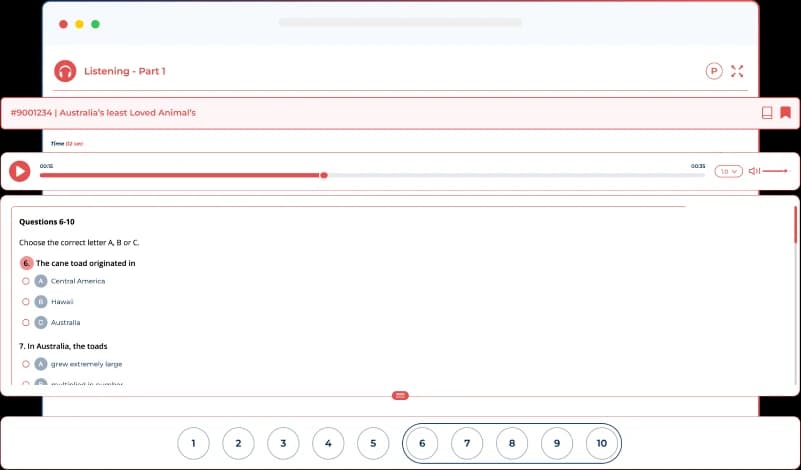
In multiple-choice type questions, there are three or four options given to test takers. Students should mark the right option after listening to the recordings. You should choose the correct answer from the given options, A, B, C, D, and write the correct letter on your answer sheet.
What skills are tested?
It evaluates your listening skills. It identifies how carefully you listen to recordings, understand the main points, and write correct answers in your answer sheet.
How many questions are there?
Variable

Type 2: Matching
What's involved?
You should match the list of items from the recordings to the list of options given on the question paper. After matching, you should write the correct letter on your sheet.
What skills are tested?
It tests your skills to listen to recordings for detailed information. It evaluates your ability to understand information about the type of guest house or hotel in everyday conversation. It evaluates your skills and how you choose the correct answer from a conversation between two people.
How many questions are there?
Variable
Type 3: Plan/Map/Diagram Labeling
What's involved?
You should complete labels on the plan, map, or diagram. The answers are selected from the list given on the question paper. In this question type, you should select the right words from recordings that fit in labels.
What skills are tested?
It evaluates your skills to understand image descriptions like Maps, Plans, or Diagrams and relate them to their visual representation.
How many questions are there?
Variable

Type 4: Form/note/table/flow-chart/summary completion
What's involved?
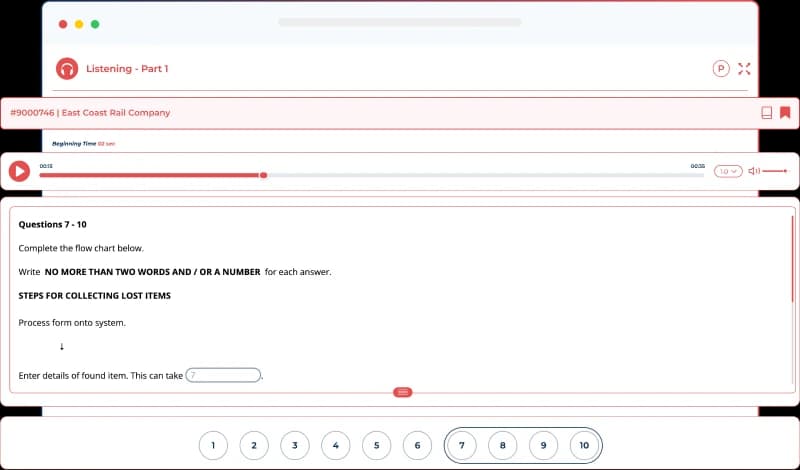
In this question type, test takers need to fill out the gaps in the listening content. It focuses on the main ideas or facts in the content. It can be notes, forms, tables, or flow charts.
What skills are tested?
It tests your skills to understand the main points in the recordings
How many questions are there?
Variable
Type 5: Sentence Completion
What's involved?
In this question type, you need to complete a set of sentences and summarize important information in recordings. Test takers should fill gaps in each sentence by using the information given in the recordings. You should read all instructions carefully before noting down answers on the answer sheet.
What skills are tested?
It tests your skills to analyze the main idea in listening to the text and determine important information from the recording.
How many questions are there?
Variable

Type 6: Short-answer Questions
What's involved?
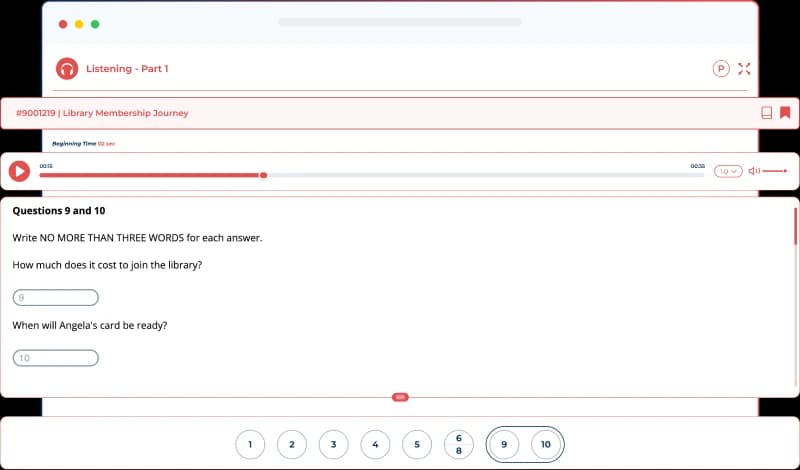
In this type of question, you should read the given questions and answer them quickly by listening to the recordings. Sometimes, you may also be asked to write down 2 or 3 different answers to the same question. It is suggested to read the instructions carefully. For example, sometimes you may answer in one or two words, or sometimes you may answer in no more than a word or a number.
What skills are tested?
It evaluates your skills in listening to places, times, or prices in a recording.
How many questions are there?
Variable
Ready to Start
Sign up now and get a free mock test with instant AI scoring and Feedback. No credit card required

General Tips on Listening Format in IELTS Academic
IELTS test listening practice is required for targeted study and building test-taking strategies. The IELTS listening mock test covers the full syllabus and enhances your management skills. IELTS education facilities conduct normal practice tests, or you could take the IELTS listening test online from validated resources. Here are some effective tips to improve your Academic listening practice



Frequently Asked Questions
Is IELTS Academic Listening different from IELTS General Listening?

No, the IELTS academic listening is not different from the IELTS General Listening test. Both tests are the same in academics and in general.
How can I improve my IELTS academic listening skills?
You should practice regularly with official listening materials, such as podcasts, sample tests, and videos. These materials help you to improve your listening skills. AlfaIELTS experts suggest you focus on different contexts and accents to prepare well.
What if I miss an answer in the recording?
If you missed the answers to listen to the recording, then move on. Don’t get stuck on missed answers. You should continue listening and focus on the coming questions. It is only suggested that you look at missed questions during the designated time to check your answers.
Is there any penalty for wrong answers in the IELTS listening test?
No, there is no penalty for candidates for giving wrong answers in listening tests, but still, you should attempt every question carefully by listening to the recordings.
How long are passages in IELTS Listening?
The IELTS academic listening test consists of long passages, for around 3-4 minutes each.





Melbourne:
Level 3, 7 Jeffcott Street
Melbourne VIC3003
Adelaide:
Level 30, Westpac House,
91 King Willam Street,
Adelaide SA - 5000
India:
Suite 514, Unit No 203,
SBR CV Towers, Madhapur,
Hyderabad, India


IELTS
Our Products
Others
Others
All rights reserved © Alfa Pty Ltd, 2026


