
About the IELTS General Training Speaking Format
The IELTS Speaking test is designed to assess your English speaking skills through a face-to-face interview with a certified IELTS examiner. The test is recorded to ensure accuracy and may be reviewed if needed. The duration of the Speaking test is between 11 and 14 minutes, and is divided into three parts.


Marking Criteria
Your speaking performance is assessed by certified IELTS examiners based on the following four key criteria:
Fluency and Coherence
This criterion evaluates how smoothly and naturally you speak, without excessive pauses or hesitation. It also assesses how well you organize your ideas, structure your sentences logically, and use cohesive devices (such as linking words and pronouns) to make your speech easy to follow.
Lexical Resource
This looks at how wide and exact your vocabulary is, and how effectively you use it to communicate ideas. It also considers your mastery in using different words or terms when you don’t know the exact term.
Grammatical Range and Accuracy
This evaluates how well you use a variety of grammatical structures and how perfectly and appropriately you apply them in your speech.
Pronunciation
This measures how absolutely you speak and how smoothly others can understand you without needing extra action.
Tasks in IELTS General Training Speaking
There are 3 parts in the IELTS Speaking Test. Let us describe all parts in detail below.
Part 1 – Introduction and Interview
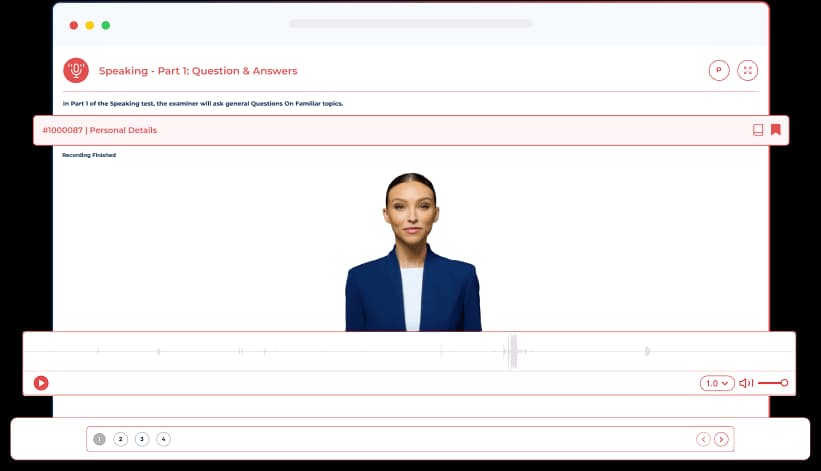
The IELTS speaking part 1 is the introduction and interview section of the test. In this part, you will be greeted by the examiner, and he (or she) will verify your identity by asking for your passport or ID. They then engage you in short conversations on two or three familiar topics. Depending on how detailed your answers are, you need to respond to 6-10 questions in total.
What's involved?
- Part 1 of the general training speaking test begins with your personal information like name, background and hometown.
- Remember, your scoring begins only when the examiner starts recording the test.
- The common topics for Part 1 of the general training speaking test are work and education, your interests, studies, friends, relatives, hometown, professional goals and so on.
- Part 1 is 4–5 minutes long.
What skills are tested?
This part of the speaking test evaluates your skills to convey ideas and views on daily topics, or share common experiences through a range of questions.
Part 2 – Long Turn / Cue Card
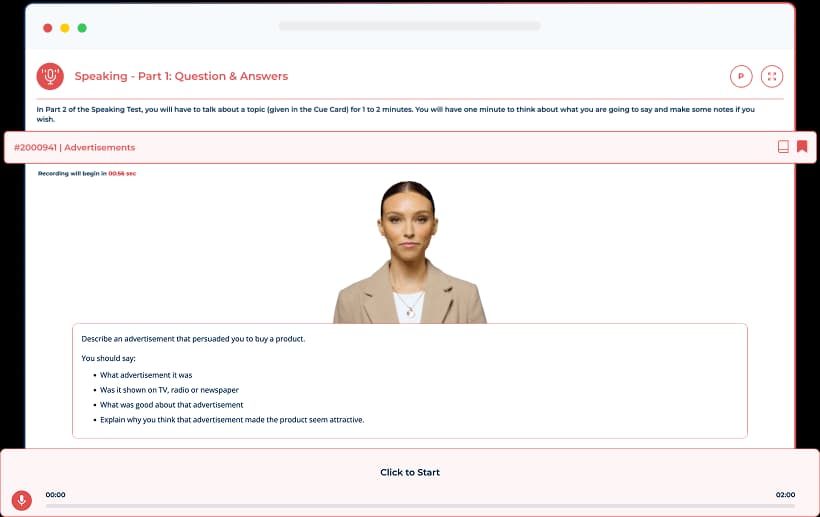
In the IELTS Speaking Part 2, the examiner gives you a task card that consists of a specific topic and a list of points you should cover in your speech. You get 1 minute to prepare to talk on the topic and make notes with a pencil and paper. After preparation, you are allowed to speak on the topic for 1-2 minutes without disruptions. Once you finish speaking, the examiner may sometimes ask you some short follow-up questions to end the section.
What's involved?
The cue card you get from the examiner consists of a single topic with prompts. For example, you may be asked to speak on a favourite place you visited, with prompts like when you visited it, why you liked it, who you visited with, and how you felt after visiting the place.
What skills are tested?
Part 2 evaluates your skills to speak at length on the given topic by using appropriate language.
Part 3 – Discussion
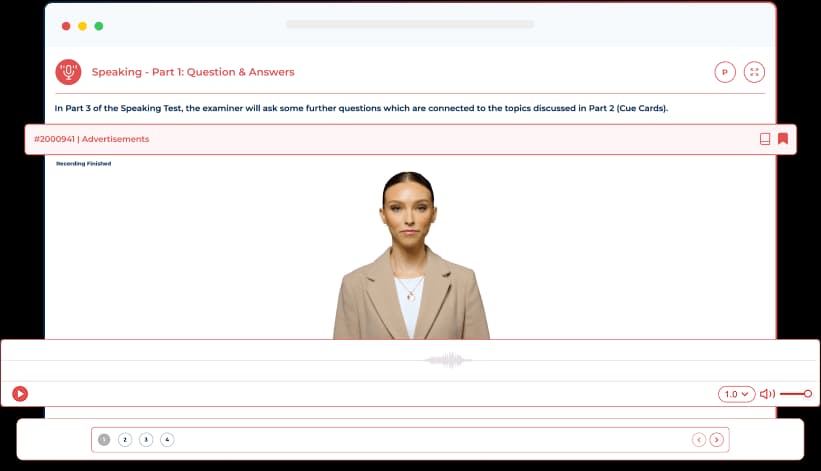
This part involves a follow-up discussion between the examiner and the test taker based on the topic used in part two. The questions in this part are more analytical and abstract in nature. The questions are designed to make you express opinions, justify ideas, make comparisons, provide solutions to problems, predict possible situations, and explore broader perspectives.
What's involved?
It involves an extended discussion on the topic you have in Part 2. If you speak about your favourite book in Part 2, the questions in Part 3 may be as follows:
- What is the role of books in shaping an individual's character?
- How have people’s reading habits changed from the past?
- Will books remain popular in the future as well?
What skills are tested?
Part 3 evaluates your skills to analyze topics, express views, justify opinions, talk about solutions to problems, make comparisons, and evaluate and organize ideas.
Ready to Start
Sign up now and get a free mock test with instant AI scoring and Feedback. No credit card required




Frequently Asked Questions
What is the duration of the IELTS General Training speaking test?

The duration of IELTS speaking tests is 11-14 minutes. Part 1 lasts for 4-5 minutes. Part 2 takes 3-4 minutes, and Part 3 takes 4-5 minutes.
Is the IELTS Speaking test conducted on the same day?
On the basis of the test centre, sometimes the speaking test is conducted on the same day. In some cases, the speaking tests are also conducted a week before or after other tests.
Is the IELTS speaking test difficult?
No, the speaking test is not very difficult if you prepare for it consistently. With your efforts, dedication, and confidence, you can master speaking tests and score high.
What is the lowest score in IELTS General Training Speaking?
The IELTS speaking section score ranges between 0 and 9. 9 is the highest score and 0 is the lowest score in this speaking test.
Is the IELTS general speaking test the same as the academic test?
Yes, the IELTS general speaking test is the same as the academic test.