



About the IELTS General Training Listening Format
The IELTS Listening test of the General Training format is designed to assess your ability to understand main ideas, specific information, opinions, and the development of arguments. It also evaluates how well you recognize the attitudes and purpose of speakers.
You will listen to four recordings and answer a total of 40 questions:
- Recordings 1 & 2: Focus on everyday social situations.
- Recordings 3 & 4: Relate to educational or training contexts.
- In Recordings 1 and 3, you’ll hear a conversation between two or more speakers.
- In Recordings 2 and 4, you’ll listen to a monologue (one person speaking).
You must listen carefully and answer the questions as you hear the information, as the recordings are played only once.

Total Duration
Around 30 minutes (plus an extra 10 minutes to transfer answers to the answer sheet, for paper-based test)

Total Sections
4

Total Questions
40

Scoring
Each correct response earns 1 mark. Your overall result is presented as a band score, rounded to the nearest whole or half band (e.g., 5.5 or 7.0).
IELTS General Training Listening Parts
The IELTS Listening test consists of four parts, each featuring different types of recordings. These include both conversational and monologue-style recordings, designed to test your ability to understand spoken English in a variety of contexts.
Part 1: Everyday Social Conversations
This section features a conversation between two people in an everyday social context—often a telephone or face-to-face dialogue. The topic typically involves practical, non-academic situations, such as booking a service or making inquiries.
Example: A man wants to book a hotel room and calls the staff, and asks about check-in time, room charges and facilities. The conversation between the man and the hotel staff is an example of Part 1. In this part, the receptionist gives details and answers all the queries.
Example: A man wants to book a hotel room and calls the staff, and asks about check-in time, room charges and facilities. The conversation between the man and the hotel staff is an example of Part 1. In this part, the receptionist gives details and answers all the queries.
Part 2: Social Context – Monologue
This part includes a monologue (one speaker only) in a non-academic context. It may be a speech, public announcement, or recorded message related to daily life or general interest.
Example: Example: A city official launches a new public library and gives a speech on it. It describes services, operation hours, and the membership process.
Example: Example: A city official launches a new public library and gives a speech on it. It describes services, operation hours, and the membership process.
Part 3: Academic or Training Context – Discussion
In this section, you’ll hear a conversation between 2 to 4 people, typically set in an academic or training-related environment. The speakers may be students discussing coursework or a tutor interacting with students.
Example: A group of 11th-class students discusses how to split tasks for group assignments. They agree or disagree with each other, express their opinions, and assign roles to every group member.
Example: A group of 11th-class students discusses how to split tasks for group assignments. They agree or disagree with each other, express their opinions, and assign roles to every group member.
Part 4: Academic Lecture - Monologue
This part features a lecture or presentation by a single speaker on an academic subject. It is more formal and structured, requiring focus on key points, examples, and detailed information.
Example: A professor gives a lecture on global warming, explains its scientific terms, gives statistics, and summarizes the key environmental impacts
Example: A professor gives a lecture on global warming, explains its scientific terms, gives statistics, and summarizes the key environmental impacts
Types of Questions in the IELTS General
Training Listening Test
In the IELTS General Listening section, there are various types of questions asked. Below is a breakdown of each type:
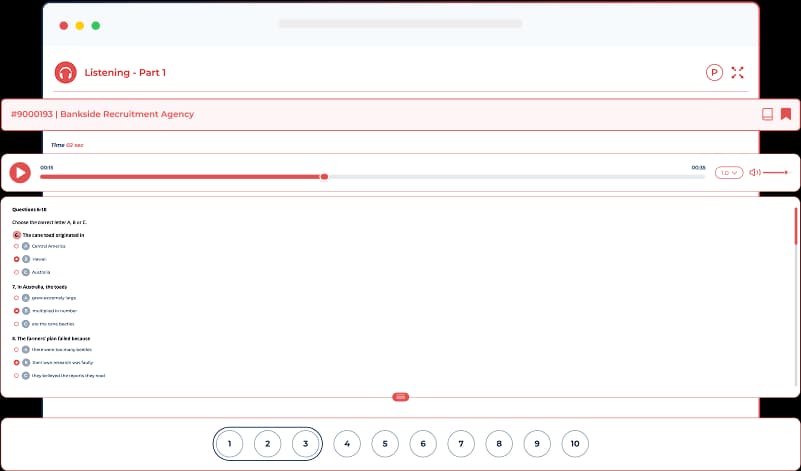
Type 1 - Multiple choice
What's involved?
You’ll be given a question with three possible answers (A, B, or C). Sometimes, you may see a longer list and need to choose more than one correct answer. Read the instructions carefully before answering.
What skills are tested?
Your ability to identify key ideas and specific details in the recording.
How many questions are there?
Variable
Type 2 - Matching
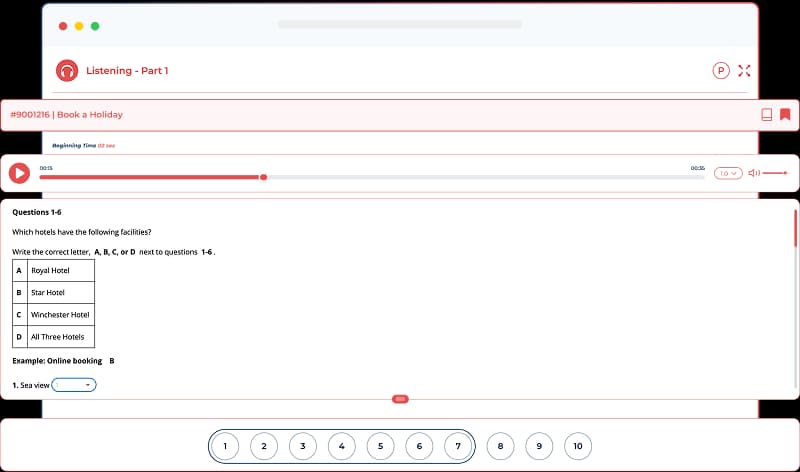
What's involved?
Match a list of options to a set of items in the audio. You’ll write the correct letter (A, B, C, etc.) on your answer sheet.
What skills are tested?
Your ability to follow a conversation and understand detailed information.
How many questions are there?
Variable
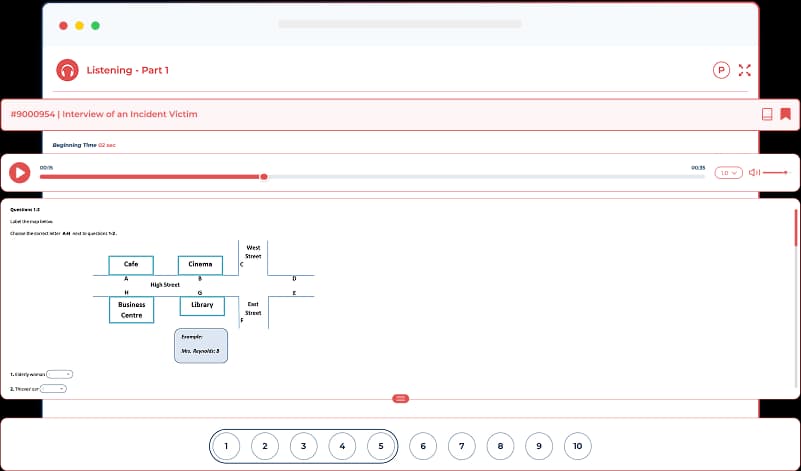
Type 3 - Plan/Map/Diagram Labeling
What's involved?
You’ll label a visual (plan, map, or diagram) using information from the recording. You may need to select from a list or complete the labels using words from the recording.
What skills are tested?
It tests your ability to understand the description of the place and how this description relates to visuals. It also evaluates your skills to understand the directions of things.
How many questions are there?
Variable
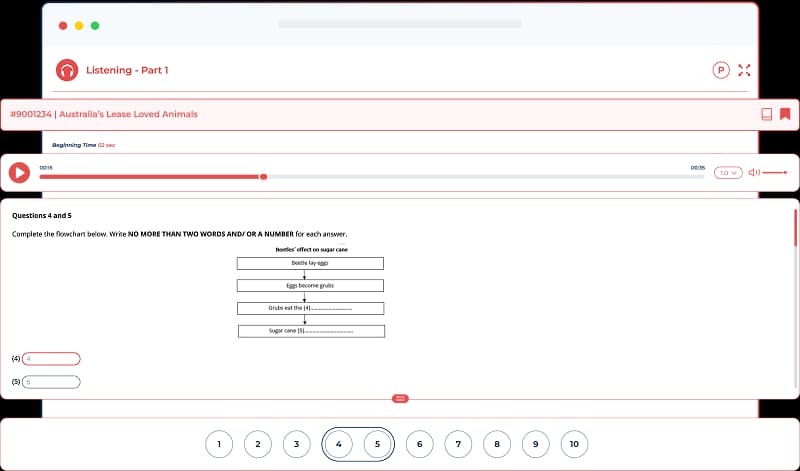
Type 4 - Form/Note/Table/Flowchart/Summary Completion
What's involved?
Fill in missing information based on a recording. The format may be a form, table, summary, or flowchart. Answers must match the wording you hear (don’t paraphrase).
What skills are tested?
It tests your skills to listen to recordings clearly and to naturally write down answers from recordings.
How many questions are there?
Variable
Type 5 - Sentence Completion
What's involved?
In this question type, you need to summarize the important information from a set of sentences in the recording. You should fill gaps in every sentence by using information in the recording. Ensure to read the instructions before noting down answers.
What skills are tested?
It evaluates your skills to determine important information in recordings. It checks your ability to understand relationships between facts, ideas, and events.
How many questions are there?
Variable
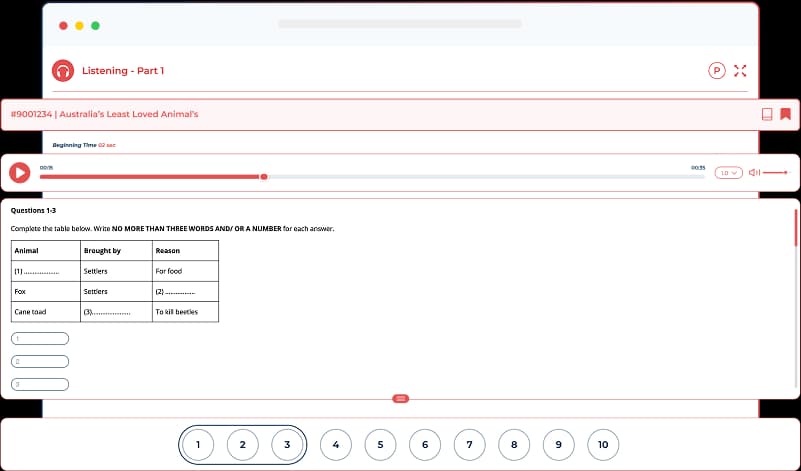
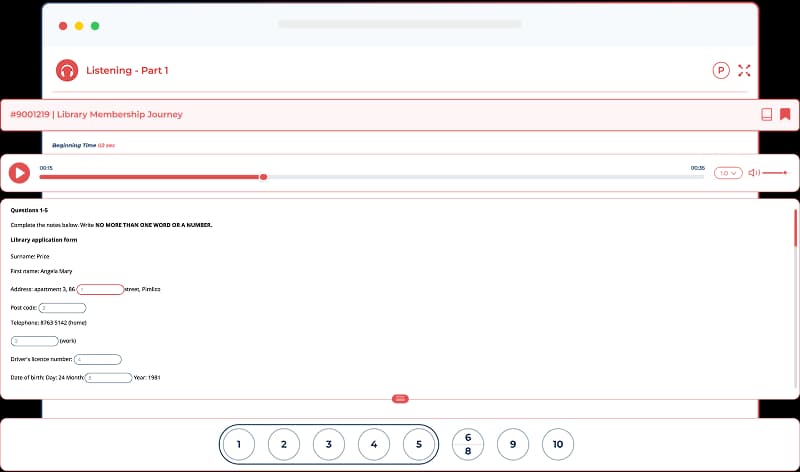
Type 6 - Short-Answer Questions
What's involved?
In this question type, you need to summarize the important information from a set of sentences in the recording. You should fill gaps in every sentence by using information in the recording. Ensure to read the instructions before noting down answers.
What skills are tested?
It evaluates your skills to determine important information in recordings. It checks your ability to understand relationships between facts, ideas, and events.
How many questions are there?
Variable
Ready to Start
Sign up now and get a free mock test with instant AI scoring and Feedback. No credit card required




Frequently Asked Questions
Can I pause or stop the audios during the IELTS listening test?

No, you cannot pause or stop the audio during the IELTS Listening test. The recording plays continuously, and you must answer the questions as you listen.
What accents are used in the IELTS listening test?
The IELTS Listening test includes a variety of native English accents, such as British, Australian, New Zealand, Canadian, and American, to reflect the international nature of the test.
How to prepare for the IELTS Listening test online?
You can prepare for the IELTS Listening test online by practicing with the practice questions & mock tests available on Alfa IELTS, listening to English audio content, and completing self-access lessons. Focus on improving your listening speed, vocabulary, and note-taking skills.
How to get 8.5 in IELTS Listening?
To achieve an 8.5 band score in the listening test, you need to answer 37 to 38 questions correctly. You should identify keywords carefully, focus on your pronunciation, listen to recordings carefully, and maintain the word limit.
How to improve IELTS Listening skills?
You must practice regularly on Alfa IELTS listening materials along with other available materials, like podcasts, sample tests, videos, etc. It improves your IELTS Listening skills.





Melbourne:
Level 3, 7 Jeffcott Street
Melbourne VIC3003
Adelaide:
Level 30, Westpac House,
91 King Willam Street,
Adelaide SA - 5000
India:
Suite 514, Unit No 203,
SBR CV Towers, Madhapur,
Hyderabad, India


IELTS
Our Products
Others
Others
All rights reserved © Alfa Pty Ltd, 2026


