It is an essay where you discuss both pros and cons, and give your opinion about which is stronger.
Summarise blog with AI


Table of Contents
- IELTS Exam 2026 – Overview Table
- Many students are confused about the IELTS application process
- How to Apply for the IELTS Exam in 2026
- Here is a Flow Graph to Clarify the Process
- Types of IELTS Tests
- IELTS Exam Eligibility in 2026
- Documents Required for IELTS Registration
- IELTS Exam Fee in 2026
- How to Apply for the IELTS Exam in 2026
- Important Tips Before Booking Your IELTS Exam
- What Happens After You Register for IELTS?
- IELTS Exam Result and Score Validity
- FAQs
- Q1. What is an Advantage Outweighing Disadvantage Essay in IELTS?
- Q2. How Do You Structure This Essay?
- Q3. Is It Necessary to Discuss Both Sides?
- Q4. How Can I Get Band 7+?
- Q5. What Vocabulary Should I Use?
- Q6. How Can I Apply for the IELTS Exam in 2026?
- Q7. What Documents Are Required for IELTS Registration?
- Q8. How Much is the IELTS Exam Fee in 2026?
- Q9. Can I Change My IELTS Test Date After Booking?
- Q10. How Many Times Can I Take the IELTS Exam?
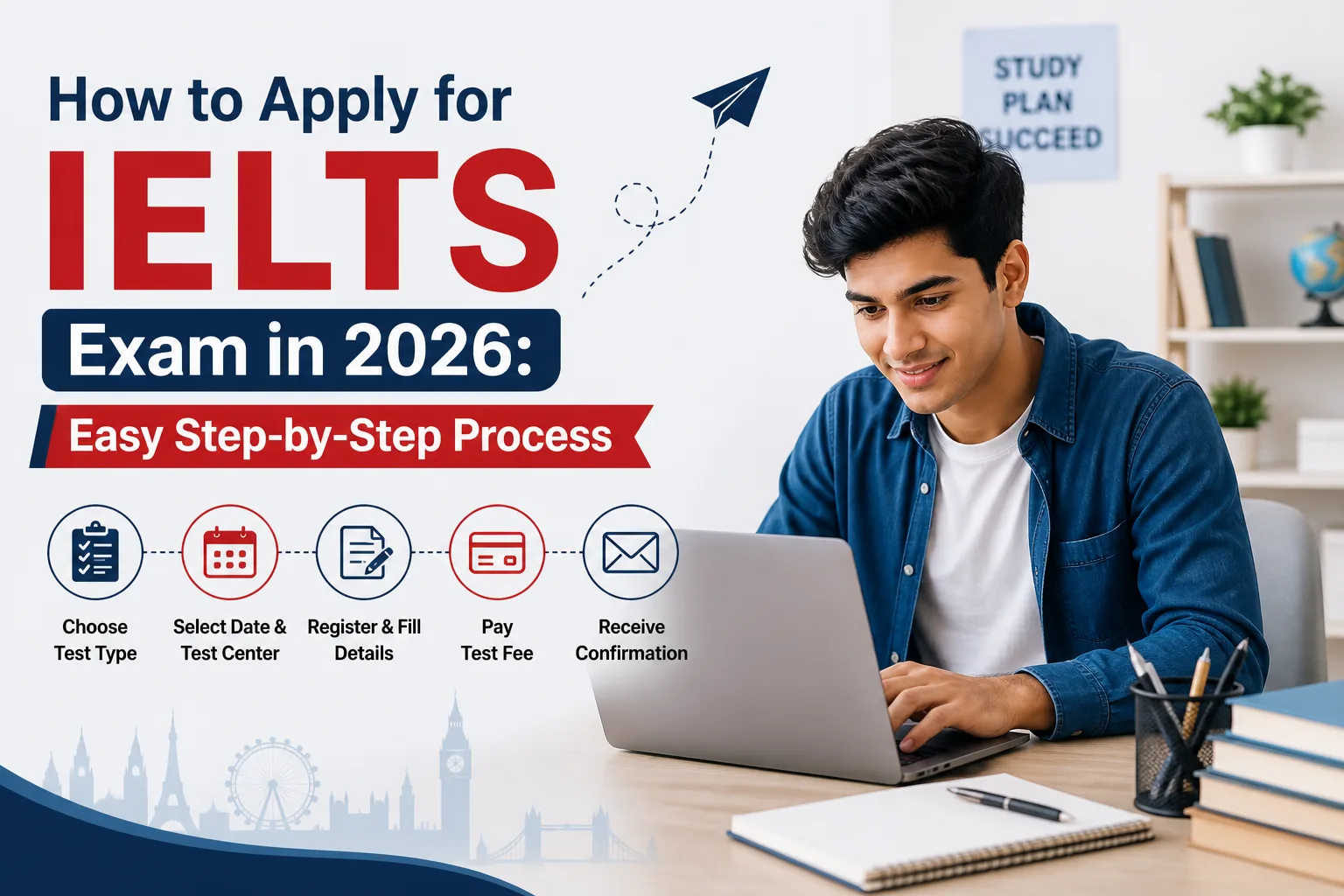
How to Apply for IELTS Exam in 2026: Easy Step-by-Step Process
- 16 min read

Last updated on 05 May 2026
Summarise blog with AI
The IELTS (International English Language Testing System) is an English proficiency exam that assesses a non-native speaker's English proficiency level. This test has four language skills: listening, reading, writing, and speaking. It is commonly required for study, work, and immigration.
Additionally, it gives universities, employers, professional organizations, and immigration authorities an opportunity to understand whether a person can use English effectively in real-life and academic or professional situations.
For study, it shows that a student can understand lectures, read academic materials, and write assignments. On the other hand, it proves the ability to communicate clearly with colleagues, clients, or patients; and for immigration or work.
IELTS Exam 2026 – Overview Table
| Category | Details |
|---|---|
| Test Types | Academic, General Training, UKVI, Life Skills |
| Test Formats | Computer-Based, Paper-Based |
| Minimum Age | 16 years |
| ID Required | Valid Passport (compulsory) |
| Registration Mode | Online (official websites) or Offline (test centers) |
| Sections | Listening, Reading, Writing, Speaking |
| Duration | About 2 hours 45 minutes |
| Result Time | Computer: 3–5 days, Paper: ~13 days |
| Score Validity | 2 years |
| Fee (India) | Approx. ₹18,000 – ₹19,000 |
| Fee (Nepal) | Approx. NPR 33,000 – NPR 36,000 |
| Retake Limit | Unlimited (pay fee each time) |
| Test Centers | Available in major cities worldwide |
Many students are confused about the IELTS application process
Students are often confused about the IELTS application process. It involves several steps such as choosing the correct test type (Academic or General Training), finding an available test date, registering through official platforms, and understanding the required documents and fees.
So, this article is useful to let you know the step-by-step process to apply for the IELTS.
How to Apply for the IELTS Exam in 2026
1
Choose the test type
Find if you need IELTS Academic (for study) or IELTS General Training (for work or immigration).
2
Find a test center or online option
Visit the official IELTS website (British Council, IDP, or Cambridge) to locate a nearby test center.
3
Check available dates
Choose a suitable test date that helps you to take the IELTS date.
4
Register for the test
Fill out the application form online. You can create an account and provide your personal details.
5
Upload required documents
Submit a valid identification document (usually a passport).
6
Pay the test fee
Complete the payment using available methods such as card, bank transfer, or other local options.
7
Receive confirmation
After successful registration, you will get a confirmation email with your test details.
8
Prepare for the exam
Use official materials and practice tests to get ready.
9
Take online or offline classes
Taking a class is important. Your mentor will guide you and help you get your desired score.
10
Attend the test
Arrive on time at the test center. Keep your baggage in a locker, and also take your ID with you.
Here is a Flow Graph to Clarify the Process
Start
↓
Visit Official Website (IDP / British Council)
↓
Create Account (Email + Password)
↓
Choose Test Type (Academic / General Training)
↓
Choose Test Center & Date
↓
Fill Personal Details (Name, DOB, Passport Info)
↓
Upload Passport Copy
↓
Make Payment
↓
Receive Confirmation Email
↓
Start Preparation
↓
End
Types of IELTS Tests
IELTS Academic
IELTS Academic is for students who want to study in a college or university in countries like the UK, Australia, Canada, New Zealand etc. This test checks your English skills in an academic environment, like reading textbooks, writing essays, listening to lectures, and speaking clearly.
It has four parts: IELTS Academic Listening, IELTS Academic Reading, IELTS Academic Writing, and IELTS Academic Speaking. The questions are based on educational topics. It helps show if you are ready to understand and succeed in higher studies.
IELTS General Training
It is for people who want to work, migrate, or live in an English-speaking country like the UK, Canada, or Australia and New Zealand. The general training test checks your basic English skills needed for everyday life, such as understanding conversations, reading notices or emails, and writing simple letters.
Like AT, it also has four parts: IELTS General Training Format Listening, IELTS General Training Format Reading, IELTS General Training Format Writing, and IELTS General Training Format Speaking. The questions are easier than those in the Academic test. Moreover, this test focuses on real-life situations, helping to show if you can communicate well in everyday situations. Questions in the reading and writing modules are different between Academic and General Training tests.
IELTS for UKVI
IELTS for UKVI is a special version of the IELTS test approved by the UK government for visa and immigration purposes. It is for people who want to study, work, or live in the United Kingdom. The test checks your English skills in Listening, Reading, Writing, and Speaking, just like other IELTS practice tests.
IELTS Life Skills
IELTS Life Skills is a normal English test. It is for the people who need a visa to live in the UK with family or for settlement. It focuses only on speaking and listening skills, not reading or writing. It is usually required for certain UK visa types, such as family or spouse visas.
IELTS Exam Eligibility in 2026
Minimum age requirement now (16 years).
According to the current situation, the minimum age requirement for IELTS is 16 years. You should be at least 16 years old to take the test. While there is no strict upper age limit, the test is mainly designed for each age group including students and adults who plan to study, work, or migrate to an English-speaking country.
Educational requirements.
Educational requirements for IELTS are just open for all. Anyone can take the test, regardless of their school or college background. You do not need a specific qualification to apply. However, IELTS is mainly useful for students who want to study abroad, or for people planning to work or migrate to English-speaking countries.
Who should take IELTS Academic vs General Training.
- IELTS Academic: This test is best for students who want to study at a college or university in an English-speaking country. It is also needed for some professional registrations (like doctors or engineers).
- IELTS General Training: This test is suitable for people who want to work, migrate, or settle in countries like Canada, Australia, or the UK. It focuses on everyday English skills used in daily life and work.
Documents Required for IELTS Registration
1
Valid Passport (compulsory ID)
A valid passport is compulsory for IELTS registration and test day. You must use your passport as your main identification document when booking the test, and you need to bring the same passport to the test center.
2
Personal details
To register for IELTS, you need to provide some basic personal information. This includes your full name (as in your passport), date of birth, gender, nationality, and passport number. You also need to give your contact details like phone number and email address.
3
Payment Method
To book your IELTS test, you need to pay the test fee using available payment options. Common methods include online payment through debit or credit card, mobile banking, or bank transfer. In some test centers, you can also pay in cash at the office. Check it online, or visit your nearest test center for more details.
4
Email ID and Phone Number
When registering for IELTS, you must provide a valid email ID and phone number. These are important because all important updates—like test confirmation, exam date, and results—are sent to your email. Your phone number may be used for reminders or urgent communication from the test center. Make sure both are active and correct so you don't miss any important information.
IELTS Exam Fee in 2026
1. Approximate IELTS exam fees in India
The IELTS exam fee in India is around ₹19,000 for most test types like IELTS Academic and General Training.
Other related fees are slightly different:
- IELTS for UKVI: about ₹19,250
- IELTS Life Skills: about ₹18,000
Overall, you can say that the IELTS exam fee in India is around ₹18,000 to ₹19,000, depending on the test type.
2. Fees may vary by country and test type
The cost of the IELTS exam is not the same everywhere. It can change depending on the country where you take the test and the type of IELTS exam you choose (Academic, General Training, UKVI, or Life Skills).
Each country has its own pricing set by local test centers, so the fee in Nepal, India, or other countries may be different. Also, some test types like UKVI may cost slightly more than others. It is always best to check the official IELTS website or your nearest test center for the exact fee.
Payment options available during registration.
- Online payment: You can pay using a credit card or debit card during online registration.
- Net banking / digital payment: Many centers allow payment through net banking or online payment gateways.
- Bank transfer: You can transfer the fee directly from your bank account.
- Cash payment: If you register offline, you can pay cash at the test center or bank.
- Demand draft / bank deposit: Some centers accept payment through demand draft or depositing cash at selected banks.
How to Apply for the IELTS Exam in 2026
1
Step 1: Visit the Official IELTS Registration Website
Students can register for the IELTS test in two main ways: online and offline. The easiest way is to register online through the official IELTS websites like British Council or IDP IELTS. You can create an account, choose your test type (Academic or General), select a test date, and pay the fee online.
Students can also register offline by visiting a nearby IELTS test center or authorized office. There, you can fill out a paper application form, submit your passport copy, and pay the fee through available payment methods.
It is always recommended to use official websites or authorized centers to ensure your registration is safe and valid.
2
Step 2: Create Your IELTS Account
To register for IELTS, you first need to create an account using your email ID on the official website such as British Council or IDP IELTS. Enter your email address and create a password to sign up.
After that, you need to fill in your personal details. This includes your full name (exactly as in your passport), date of birth, gender, nationality, passport number, and contact details like phone number and address.
Once all details are entered, check everything carefully to make sure it matches your passport. Then you can choose your test type, select a test date, and continue with the payment to complete your registration.
3
Step 3: Choose the IELTS Test Type
IELTS Academic: Choose this test if you want to study in a college or university abroad or apply for professional registration (like doctors, engineers, etc.). It focuses on academic English, such as reading textbooks, writing essays, and understanding lectures.
IELTS General Training: Choose this test if you plan to work, migrate, or settle in an English-speaking country like Canada, Australia, or the UK. It focuses on everyday English used in daily life, workplaces, and social situations.
Simple tip: Study abroad = Academic | Work / PR / migration = General Training
4
Step 4: Choose Test Location and Test Date
Students can easily choose a nearby IELTS test center while registering online. First, go to the official website of the British Council or IDP IELTS and start the registration process. After selecting the test type (Academic or General Training), you will be asked to choose your location.
You can enter your city or area name, and the website will show a list of available test centers near you along with dates and seat availability. Students can compare options and select the most convenient center based on distance and preferred test date.
If registering offline, you can visit the nearest authorized IELTS center, and the staff will help you choose a nearby test location and date.
5
Step 5: Fill in Personal and Passport Details
Providing accurate information during IELTS registration is very important because all your details must match your passport. If there is any mistake in your name, date of birth, or passport number, you may face problems such as being denied entry to the test or delays in getting your results.
Correct information also ensures that your test results and certificates are issued properly and accepted by universities, employers, or immigration offices. Even small errors can create serious issues later. So, it is always important to check everything carefully before submitting your application.
6
Step 6: Upload Required Documents
When applying for IELTS, you are usually required to submit a clear copy of your valid passport. This is used to verify your identity during registration. The copy should include your photo, full name, passport number, and date of birth.
On the test day, you must also bring the original passport, not just the copy. The details on your application must exactly match your passport. Without a valid passport, you will not be allowed to take the IELTS exam.
7
Step 7: Pay the IELTS Exam Fee
When booking your IELTS test, you can choose from several payment methods depending on your country and test center.
- Online payment: Pay using a debit card or credit card during registration.
- Net banking / digital wallets: Some centers allow online banking or mobile payments.
- Bank transfer: You can transfer the fee directly from your bank account.
- Cash payment: If you register at a test center, you may be able to pay in cash.
- Demand draft / bank deposit: Some centers accept payment through demand draft or by depositing money in a bank.
Check Your IELTS Readiness Before Booking
Check Your IELTS Readiness Before BookingImportant Tips Before Booking Your IELTS Exam
Before registering for IELTS, make sure your passport is valid. It should not expire on the day of the test. The passport is the only accepted ID in most countries, so your details (name, date of birth, passport number) must be correct and match your application.
You should also ensure that your passport is in good condition and clearly readable. If your passport expires soon, it is better to renew it before booking the test to avoid any problems on exam day.
Choose the correct test type.
You need to choose and understand which type of test best suits you. The General Training test is easy whereas the Academic test is hard. Question patterns in these two types also vary in the Reading and Writing modules.
What Happens After You Register for IELTS?
1
Confirmation email
After registration, you will receive a confirmation email with your test date, time, test center, and payment details. Always check that all information is correct.
2
Test preparation
You can start preparing using practice tests, sample questions, and study materials. This is the best time to plan your study and improve your skills.
3
Admit card details
You will get an admit card or test confirmation details (sometimes by email). It includes important information like your reporting time, venue, and instructions for the exam.
4
Test day instructions
You will receive guidelines on what to bring (like your original passport), what time to arrive, and rules to follow during the test. Reading these instructions carefully helps avoid any problems on exam day.
IELTS Exam Result and Score Validity
1
When results are released
IELTS results are usually available within 3–5 days for computer-based tests and around 13 days for paper-based tests. You can check your results online using your login details, and you may also receive an official Test Report Form (TRF).
2
Score validity (2 years)
Your IELTS score is valid for 2 years from the test date. After this period, the score expires, and you will need to take the test again if required for study, work, or migration purposes.
Start Your IELTS Preparation Today
Start Your IELTS Preparation TodayRegistering for IELTS is simple and can be done online or at a test center. It is strongly recommended to apply early because test slots fill up quickly, especially on preferred dates. Early booking also gives you enough time to prepare well, practice all sections, and improve your confidence. Starting your preparation early can make a big difference in achieving a high score.
Also Read: IELTS Advantage Outweigh Disadvantage Essay: Structure, Tips, Samples & Band 9 Strategy
FAQs
Q1. What is an Advantage Outweighing Disadvantage Essay in IELTS?
Q2. How Do You Structure This Essay?
Use an introduction (include your opinion), two or three body paragraphs, and a conclusion.
Q3. Is It Necessary to Discuss Both Sides?
Yes, always discuss both sides and clearly state your opinion.
Q4. How Can I Get Band 7+?
You can achieve Band 7 or higher by using clear language, relevant examples, strong structure, and accurate grammar.
Q5. What Vocabulary Should I Use?
Use simple present tense and linking phrases such as "One advantage is," "A drawback is," "However," "Although," and "Additionally."
Q6. How Can I Apply for the IELTS Exam in 2026?
You can apply through the official IELTS websites such as IDP IELTS or the British Council. Simply click on "Book Test" or "Register," choose your preferred test type, date, and location, and complete the online registration process.
Q7. What Documents Are Required for IELTS Registration?
The IELTS registration process is simple and requires a few important documents:
- Valid passport (mandatory): You must provide a clear copy and bring the same passport on test day.
- Passport-size photograph: Some test centers may require a recent photo.
- Payment confirmation: Keep your fee receipt or confirmation for reference.
Q8. How Much is the IELTS Exam Fee in 2026?
The IELTS exam fee varies by country and test type:
India:
- IELTS Academic / General Training: ₹19,000
- IELTS for UKVI: around ₹19,250
- IELTS Life Skills: around ₹18,000
Nepal:
- IELTS (Computer-based): around NPR 33,000
- IELTS (Paper-based): around NPR 36,200
- IELTS for UKVI: around NPR 36,400
Q9. Can I Change My IELTS Test Date After Booking?
Yes, you can reschedule your IELTS test date. If you request the change early (usually 5 weeks or more before the test), it may be free or cost less. Late changes may require a transfer fee depending on the test center policy.
Q10. How Many Times Can I Take the IELTS Exam?
There is no limit to how many times you can take the IELTS test. However, you must register and pay the full fee each time. It is recommended to prepare well before reattempting the exam.

Suresh Gajurel
Author

Tags:
Share: