This is a Reading task. You are given a list of headings, and you have to match each heading to the paragraph it best sums up. There are always more headings than paragraphs, so some are never used.
Summarise blog with AI


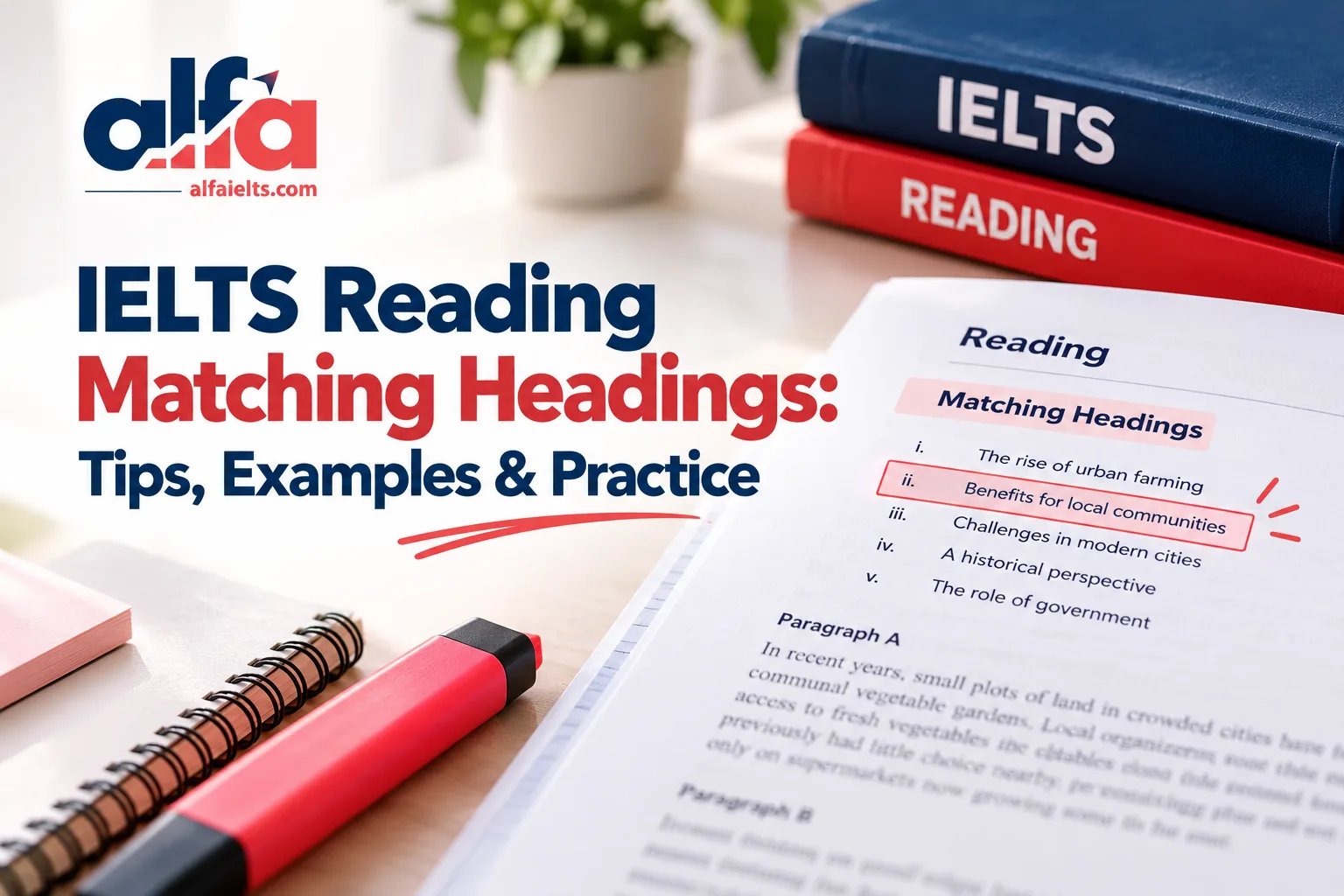
IELTS Reading Matching Headings: Tips, Examples & Practice
- 20 min read

Last updated on 08 Oct 2026
Summarise blog with AI
Let us talk about a rather common situation when you are dealing with the "Matching Headings" type of question in IELTS Reading: You read the paragraph. You understand every line. But then you look at the headings, and three of them seem like the right ones.
That's because the task is not really asking "Which heading contains words from the paragraph?" It's asking: "Which heading best represents the main idea of the whole paragraph?" Official IELTS guidance describes Matching Headings as being about identifying the main idea of a paragraph or section, and specifically points out that there will be more headings than paragraphs, so some headings are never used at all.
In Matching Headings, the loudest word in a paragraph is not necessarily the main idea. This single sentence is the key to this whole question type, and everything in this guide is based on it.
What Is IELTS Reading Matching Headings?
In this task, you are provided with multiple paragraphs or sections, along with a list of potential headings, typically denoted by Roman numerals. There are always more headings than paragraphs. You need to match the best one heading with a paragraph. Alfa IELTS's own guidance on the Reading format describes the task in the same way, particularly noting that not all headings on the list are used.
A quick original example
In recent years, small plots of land in crowded cities have been turned into communal vegetable gardens. Local organizers say these gardens have offered access to fresh vegetables in neighbourhoods that previously had little choice nearby, with residents who used to rely only on supermarkets now growing some of their own food.
Possible headings: i. The popularity of gardening as a hobby ii. urban gardens and food access iii. Problems caused by modern agriculture iv. History of Urban Planning
Answer: ii
Why? Since the main point of the paragraph is about better access to fresh food, not about gardening as a hobby, or agricultural issues, or the history of city planning, even if the setting is a city. The right heading captures what the whole paragraph is really about.
(All the examples in this guide are original, written in IELTS style, and are not from official IELTS or Cambridge tests.)
What Does Matching Headings Test?
This exercise is designed to test your ability to identify the main idea, to distinguish between main ideas and supporting details, to understand the structure of a paragraph, to identify paraphrasing, to understand how ideas relate, to summarize information concisely, and to distinguish between similar-sounding ideas.
IELTS distinguishes this specifically from Matching Information: Matching Headings is about the main idea, while Matching Information is about finding specific information.
| Matching Headings | Matching Information |
|---|---|
| Main idea | Specific information |
| Whole paragraph | Particular detail in a paragraph |
| "What is the paragraph mainly about?" | "Where is the detail mentioned?" |
| Looking for gist | Looking for information |
This distinction is worth remembering in itself, as confusing the two is one of the most common sources of error across both question types.
What Makes Matching Headings Difficult?
More Headings Than Paragraphs
Some heading options are deliberately left unused – this is a built-in feature of the task, not an accident, as confirmed by the official IELTS.
Some Headings May Seem Relevant
Headings may deal with the same general subject, but differ in scope. For example:
A. Problems caused by urban traffic B. The environmental impact of urban traffic
One paragraph might have both of the ideas, but one of the options usually represents the actual content of the paragraph more than the other.
Distractors Match One Detail
This is one of the biggest traps you'll find in all the preparation material. IDP specifically warns that headings can mislead candidates by focusing on one particular detail rather than the overall main idea of the paragraph.
Paraphrasing Hides the Answer
The passage might say: "Researchers abandoned the original approach." The heading might be: "Why an earlier method was scrapped." Same meaning, but completely different words.
Headings Don't Follow Paragraph Order
You can't assume Heading i is Paragraph A, Heading ii is Paragraph B, etc. The headings are a different, shuffled set of options – sequence of information is meaningless here.
The Golden Rule: Match the Main Idea, not a Keyword
Main idea > Keyword match
Imagine a paragraph that keeps saying electric vehicles, charging stations, batteries and emissions. A heading that says "The development of charging stations" might be attractive, but it simply repeats the vocabulary of the paragraph.
But if the paragraph really is about "How electric vehicles are changing urban transport," then the latter heading is the better answer— it captures the paragraph's broader intent, whereas the "charging-stations" heading reflects only one detail mentioned along the way.
The rule to apply every time: "If I had to put together this entire paragraph in one sentence, what would it be?" That question should be your permanent move for every paragraph in this task.
The 6-Step Matching Headings Strategy
1
Carefully Read the Heading Options First
Don't just learn the words in each heading, learn what each heading means. IDP recommends that you read all the headings carefully and rewrite them in your own words where helpful before you even look at the paragraphs.
2
Identify Differences in Similar Headings
For example: "i. The causes of climate change" vs "ii. The effects of climate change." The key difference here is causes vs effects – actively spot these contrasts before you begin matching, so you're not caught off guard in the middle of a paragraph.
3
Read Paragraph for Gist
Please do not translate each sentence literally. Instead ask: what is this paragraph up to? Is it posing a problem, explaining a cause, describing a development, offering a solution, comparing two ideas, challenging a belief that is established, or describing an effect? You will see this "paragraph purpose" approach used a lot in recent Matching Headings guides, and it works.
4
Write Your Own Mini-Heading
Before we look at the options in detail, summarize the paragraph yourself in 3-7 words - like "Why the old system failed". Then find the heading that says the same thing. This one habit does more to prevent keyword-driven mistakes than just about anything else.
5
Cross Out the Wrong Answers
Cross out headings that refer to one detail only, that refer to a different idea altogether, that are too general, too specific, or that contradict the paragraph directly.
6
Check Complete Paragraph
Before you settle on an answer, ask yourself: does this heading include most of the paragraph? If it explains only one out of 6 sentences, think again. You may have fallen into a detail trap rather than the actual main idea.
Shout You Read Headings First or the Passage First?
This is really a situation where the major preparation sources don't all agree on a fixed sequence.
- Strategy A - Headings First (IDP's approach): Read the headings, understand the meanings, identify keywords and differences between similar ones, read the paragraphs and match the best heading to each.
- Strategy B - Paragraph First: Some recent preparation guides suggest coming up with your own idea of the paragraph first, and then checking this against the headings – the idea being that this helps to avoid the temptation to look for matching vocabulary before you have actually understood the paragraph.
None of these should be taken as an official IELTS rule. Practice both ways and use the one that gives you better accuracy for you personally without slowing you down.
- Recommended Hybrid method: Read the headings briefly → skim the paragraph → create your own mini-heading → compare with options → confirm. You'll probably find that this blended approach is the most practical to incorporate into your routine.
How to Identify the Main Idea of a Paragraph
- Look for a topic sentence: This is usually, but not always, the first sentence in the paragraph.
- Watch for contrast markers: Words like but, although, nevertheless, whereas, or despite often indicate a turn toward the real point of the paragraph.
- Look for cause/effect markers: Words such as because, therefore, consequently, as a consequence connect the detail you are reading to the larger idea behind it.
- Look for a fitting conclusion: A paragraph can start with a general claim, and slowly work its way to a final point. That final point isn't clear until the end.
- But don't assume the main idea is always in the first sentence. IDP also explicitly states that candidates should read the first and last sentences but scan the rest of the paragraph, because sometimes the main idea is only clear toward the end.
Main Idea vs Supporting Detail: A Worked Example
Worked Example
Main Idea vs Supporting Detail
Paragraph: Scientists at first thought the species disappeared because of habitat loss. Later work, however, showed that changes in availability of food were far more important. Researchers now say a combination of several environmental pressures combined to cause the decline.
Possible headings: i. A fresh hypothesis for the decline of a species ii. The loss of natural habitats. iii. Importance of availability of food iv. Research methods of scientists
✦ Best Heading
i. A fresh hypothesis for the decline of a species
Why? Yes, the paragraph does talk about habitat loss and food availability. But the main purpose is the change in scientific explanation over time, from one theory to a more complete one. Headings ii and iii each grab one detail mentioned on the way, which is precisely why keyword matching is dangerous here: both 'habitat loss' and 'food availability' occur in the text, but neither captures what the paragraph is actually about as a whole.
The 5 Most Common Matching Headings Traps
1
Trap 1: The Keyword Magnet
The heading is a word repeated from the paragraph. Problem: the same word does not guarantee the same meaning.
2
Trap 2: The Detail Trap
The heading is referring to one example or statistic in the paragraph. Problem: it does not represent the paragraph as a whole.
3
Trap 3: The Too-General Heading
The heading represents the general topic area, but misses the specific focus of the paragraph.
4
Trap 4: The Too-Narrow Heading
The heading does not cover the entire paragraph, but it does describe one part of it.
5
Trap 5: The Two Identical Headings
The two headings appear similar at first glance. Solution: Compare their scope, purpose, viewpoint, direction of cause / effect, problem / solution framing, and whether one implies change or comparison that the other doesn't.
In fact, recent preparation guides have consistently identified detail-based distractors, nearly identical heading pairs, and literal keyword matching as the primary sources of error in this task – and that is why Steps 2 and 5 of the above strategy are included.
Paraphrase: The Secret Weapon
| Passage | Heading |
|---|---|
| Reduce | Cut |
| Increased rapidly | Grew dramatically |
| Researchers found | Scientists discovered |
| The previous method | The earlier approach |
| Problems emerged | Problems arose |
| Rejected the theory | Challenged the idea |
Try it yourself: "Researchers abandoned their original theory after several surprising results."
Which heading means the same thing?
A. The success of scientific experiments B. Why an earlier theory was rejected C. Developing new research methodologies D. Unexpected findings in modern science
Answer: B. Notice how "abandoned their original theory" and "an earlier theory was rejected" mean the same thing in completely different words. This is the kind of transformation you must get used to identifying quickly.
A Fast Technique: The "Six-Word Summary"
After reading each paragraph, try to summarize it in about six words before even looking at the heading options.
Example paragraph: "Researchers have demonstrated that young trees grow faster if they are exposed to long periods of natural light, compared with trees that are grown in the shade."
Your six-word summary: "Young tree growth increases with light."
Now look at the available headings and compare them to that summary – the one most similar to your own summary is almost always the right answer.
Formula: Paragraph → 6-word summary → heading. This is a very fast and repeatable technique that should be part of every practice session until it becomes automatic.
The Elimination Strategy
If the answer is not immediately obvious, go through the options systematically:
Heading A – Too broad ❌
Heading B – Matches only one example ❌
Heading C – Matches the central idea ✅
Heading D – Contradicts the paragraph ❌
Heading B – Matches only one example ❌
Heading C – Matches the central idea ✅
Heading D – Contradicts the paragraph ❌
An important warning: Elimination should support your understanding, not replace it. Even if you have eliminated three options, always check the whole paragraph for your final answer as per Step 6 above – don't just choose D because it is "the only option left."
What About the First and Last Sentences?
- Myth: "The answer is always in the first sentence."
- Reality: Occasionally, the first sentence is merely a way to introduce the topic, and the real main idea may only appear later in the paragraph.
Official IELTS teaching guidance recommends focusing on the first and last sentences and skimming the middle of the paragraph rather than jumping from one to the other.
A practical rule to remember: First sentence = hint. The last sentence = confirmation. Whole paragraph = evidence.
Should You Attempt Matching Headings First?
Some preparation sources advise doing Matching Headings early in a passage as knowing the main idea of each paragraph can be a big help for other question types later on. However, this is not a universal rule, so be sure to test the strategy against your own timing and accuracy before you commit to it.
Suggested approach: If Matching Headings appears alongside other types of questions on the same passage, try to do it early if you are already comfortable with identifying main ideas quickly. But don't force an answer—if you've tried reasonably hard and a paragraph doesn't give you a clear main idea, mark it and come back to it after you've reduced your options by answering the other questions.
Time Management for Matching Headings
Avoid rereading the entire passage from scratch for every single paragraph. Identify the obvious matches first, mark the uncertain paragraphs, move on, and then go back to them again when other matches have narrowed down your remaining choices by elimination.
There is no official rule about a fixed amount of time per heading. The IELTS Reading test is 60 minutes for 40 questions, and Matching Headings is just one possible task type you might see within that time – you must pace yourself for the whole passage, not just this single question type.
How quickly can you determine the main idea of a paragraph?
Practice Matching Headings on Alfa IELTS with a timer
Practice NowA Complete Worked Example
Try this whole exercise before looking at the answers below.
Paragraph A
Traditional Farming Method
For generations, farmers in a mountain region have used a method of crop rotation that outside experts thought to be unnecessarily slow and inefficient. Modern agricultural consultants first suggested replacing it with faster, more intensive methods. However, research has shown over the years that the old rotation was much better at preserving the soil's quality than the newer methods, and several of the "inefficient" practices are now being introduced elsewhere.
Paragraph B
Consumer Survey Findings
A recent series of consumer surveys has shown that people under thirty are buying very differently. Brand loyalty is less important to this group, who are increasingly basing their purchasing decisions on a company's environmental practices and transparency around product sourcing. Younger shoppers in particular have stopped engaging with retailers that have been slow to adapt.
Paragraph C
Technology in Developing Communities
Simply introducing new technology into a developing community does not assure the success of that community. Local infrastructure, the training available, cultural attitudes to change, and the ongoing maintenance support are all factors, and projects that ignore any one of them tend to struggle, no matter how promising the technology seemed in the early trials.
Headings: i. Traditional technique more profitable than first thought ii. Environmental costs of modern farming iii. Younger consumers are redefining brand loyalty iv. Why new technology alone isn't enough v. The challenges of rural to urban migration
Try it: 1. Read Paragraph A and provide a 5–6-word summary. 2. Choose a heading 3. Explain in your own words why each of the other options is incorrect. 4. Do the same for paragraphs B and C.
Answers
Worked Example Answers
✦ Paragraph A → i
A possible summary: "An old farming method turns out valuable". Heading ii is a trap - it mentions a related theme (agriculture), but it is about environmental cost in general, not the specific reversal described in the paragraph.
✦ Paragraph B → iii
A possible summary: "Young shoppers now care more about ethics than brands." This heading captures the paragraph's real shift in behaviour, not any single supporting detail within it.
✦ Paragraph C → iv
Plausible summary: "Technology needs more than itself to succeed." Heading v is a distractor that is not used - migration is never mentioned in the paragraph, despite the vaguely related 'developing community' setting.
(Heading ii and v are both unused – just the sort of extra, deliberately irrelevant options you'll see in a real test.)
Matching Headings Practice: Easy → Medium → Difficult
1
Level 1 — Clear Main Idea
The paragraph has a clear topic sentence and the right heading is fairly easy to spot once you've read through it once.
2
Level 2 — Paraphrased Heading
The correct heading uses noticeably different vocabulary from the paragraph itself, so you have to recognize meaning rather than match words.
3
Level 3 – Heavy Distractor
At first glance, two headings seem equally plausible, but one of the headings only covers a supporting detail and not the true main idea of the paragraph.
Mistakes Students Commonly Make
- Choosing the header with the maximum number of matching words
- Matching heading to one sentence, not the whole paragraph
- Assuming that the answer lies in the first sentence
- Ignoring paraphrasing between the passage and the headings
- Selecting the first heading that seems possible, not checking the others
- Spending too long on one difficult paragraph
- Forgetting that some headings are intentionally not used
- Reusing a heading that has already been matched to another paragraph
- Missing minor differences between similar-looking headings
- Changing an answer without any new evidence to support the change
How Alfa IELTS Can Help You Practice Matching Headings
Alfa IELTS is currently offering Academic and General Training Reading practice. It covers Matching Headings question type among the Reading question types. The platform also provides timed practice, instant scoring, performance analytics, and sectional or full mock tests.
Targeted Matching Headings Practice
Focus specifically on this sort of question rather than waiting for it to appear inside a full IELTS mock test.
Timed Reading Practice
Practice identifying main ideas without spending too much time on individual paragraphs. Understand paragraphs. Find the title. Race against time.
Full Reading Practice
Once the skill has improved in itself, put it back into the context of a full Reading Test. Alfa IELTS offers timed passages for full-length and sectional Reading practice.
Instant Scoring
See how you did immediately, rather than waiting until the end of a longer study cycle to find out.
Performance Analytics
Reading practice with Alfa IELTS enables weaker question types to be identified through performance analysis, establishing a useful cycle: Attempt → Score → Identify weakness → Practise → Retest.
Not sure if Matching Headings is really your weak point?
Discover with your Alfa IELTS performance results.
Mock TestsThe Alfa IELTS Matching Headings Practice Routine
- Before practice (2 min): Review the six-step method above.
- During practice: Read → Summarize → Match → Eliminate → Confirm.
- After practice (5 minutes): For every wrong answer, note down what happened:
| Question | My answer | Correct answer | Why I was wrong |
|---|---|---|---|
| 1 | III | IV | I matched a detail |
| 2 | I | I | Correct |
| 3 | IV | II | I missed paraphrasing |
Then return and do a fresh practice set later on, once you've had time to absorb what went wrong.
Matching Headings: Quick Checklist
Before you choose your answer, check:
- What is the paragraph mainly about?
- Can I summarize it in a few words?
- Is this the heading for the whole paragraph?
- Am I picking it for meaning or just one matching word?
- Is there another heading with a closer meaning?
- Does the heading fit the actual purpose of the paragraph?
Remember: main idea → meaning → scope → confirmation.
Don't Match Words. Match Ideas.
Matching Headings rewards the ability to step back and see what a paragraph is really doing, not the ability to spot a familiar word. Build the practice of summarizing before you choose, and the traps in this task start losing their power.
Also Read: IELTS Reading Time Management
FAQs
Q1. What is Matching Headings in IELTS Reading?
Q2. How to Answer Matching Headings Questions?
Read the headings carefully to see what they mean. Read each paragraph for general meaning, not detail. Summarize the paragraph yourself in a few words. Match that summary to the closest heading, and check that it fits the whole paragraph before you move on.
Q3. Is IELTS Matching Headings Difficult?
This is one of the more difficult Reading tasks for a lot of candidates. This is largely due to unused headings, pairs of headings and distractors that are almost identical, and distractors that refer only to one supporting detail, rather than the main idea.
Q4. Do I Start With the Passage or the Headings?
Different sources of preparation use both approaches. A practical hybrid is to skim the headings briefly, read the paragraph, make your own mini heading, and then compare it against the options – try it in practice and see what order works best for you.
Q5. How Do I Identify the Main Idea of a Paragraph?
Read the topic sentence, look for contrast and cause/effect markers, and read through to the end instead of assuming the first sentence alone tells you everything — the main idea sometimes only becomes clear when you've read the whole paragraph.
Q6. How to Avoid Distractors in Matching Headings?
Pay special attention to headings that paraphrase a keyword from the paragraph, but not its main idea, and headings that describe only one detail or example instead of the paragraph as a whole.
Q7. Are the Headings in the Order of the Passage?
No. The headings are a random list of options separate from the paragraphs, so you can't assume Heading i matches Paragraph A just because they're both listed first.
Q8. Can I Use a Heading More Than Once?
No, each title should only be used once in the entire task, and there are more titles than paragraphs, so some will be left completely unused.
Q9. Should I Read the First and Last Sentences?
Yes, they're good entry points — the first sentence tends to introduce the topic, and the last sentence tends to confirm the point of the paragraph — but you should still skim the middle, because the real main idea can sometimes be found only partway through.
Q10. How Can I Improve on Matching Headings in IELTS?
Practice the six-step strategy regularly and develop the habit of writing a short mini-summary before you look at the heading options. Afterward, go over your mistakes and see whether you are falling into keyword traps or detail traps specifically.
Q11. How Can Alfa IELTS Help Me Practice Matching Headings?
Alfa IELTS has specific Matching Headings practice, timed Reading tests, instant scoring, and performance analytics that can help you determine whether this question type really is a weak spot for you, so you can target your practice.

Ram Prasad Sharma
Author

Tags:
Share: