It is a Reading task where you match numbered statements with a list of features such as researchers, inventors, countries or categories by writing the correct letter for each statement.
Summarise blog with AI


IELTS Reading Matching Features: Tips, Examples & Practice
- 22 min read

Last updated on 13 Oct 2026
Summarise blog with AI
This guide explains what Matching Features is, what it tests, how it is different from Matching Information and Matching Headings, why test takers make mistakes, and a seven-step method for solving it. You will also get a fully worked example and three graded practice sets, all original, with answer keys and explanations.
Why Matching Features Questions can be Tricky?
You have found the right name of the researcher. But, did the researcher actually make the discovery mentioned in the question?
Let's say we have a passage with three researchers, each with a different finding. You scan for their names and find them fast. Then you pick the one whose name is closest to a familiar word in the statement. It seems efficient, and it's also one of the most common ways of losing a mark.
In Matching Features, finding the name is only the beginning. The real challenge is to match a complete statement to the right feature, using evidence in the passage and knowing that the passage will almost always state the idea in different words. A name can be mentioned four times in a passage, and only one of those sentences will be able to support the statement in front of you.
What is IELTS Reading Matching Features?
Matching Features is an IELTS Reading task in which you are given a list of statements and a list of features, and you have to match the statements to the correct features. Features are labelled with letters (A, B, C, etc.) and statements are numbered. You write the letter which is correct for each statement.
Features can be from different categories:
- Researchers, scientists and writers (e.g. findings of three different scholars)
- People and their views (e.g., educators with different views on homework)
- Inventors and inventions
- Countries, places or organizations
- Historical periods, events or categorization
Some options may be used multiple times, others may not be used at all, depending on the instructions printed with the task. Always read them. The number of Matching Features questions is not fixed; it varies from test to test.
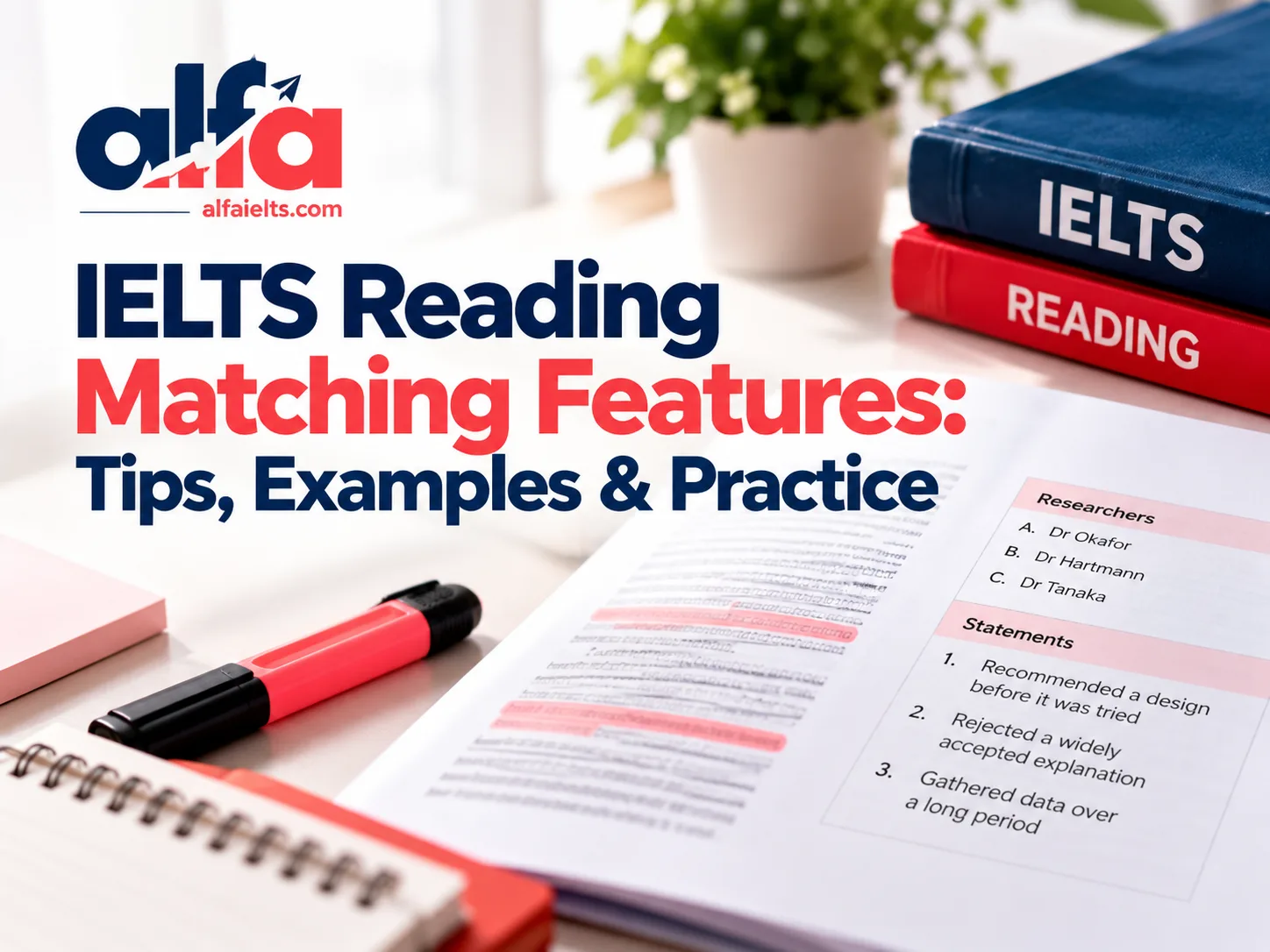
A small original illustration
List of researchers:
A. Dr Okafor B. Dr Hartmann C. Dr Tanaka
Statements:
- Recommended a design before it was tried
- Rejected a widely accepted explanation
- Gathered data over a long period
You need to decide which researcher is described by each statement based on what the passage says about each person, not on where their names appear.
What Skills Does Matching Features Test?
1. Scanning for Names and Specific Details
You have to quickly find features such as names, dates, places or inventions. They are like signposts telling you where to read closely.
Example: The options are three scientists. A quick scan for capitalized names gives you where each scientist is in the passage.
2. Recognizing Connections Between Facts
The task is to associate a person, thing or category with a particular action, assertion or outcome. Official IELTS notes that being able to spot relationships between facts is a vital skill for this task.
Example: "Dr Tanaka monitored twelve community plots" links a person (Tanaka) with an action (monitoring) and a scope (twelve plots).
3. Knowledge of Opinions, Theories and Claims
Many Tasks of Matching Features are about who believed or argued what. You need to differentiate the writer's own view from a view reported by the writer and a view the writer disagrees with.
Example: "Idris maintains that the benefit comes from routine" attributes a specific claim to Idris, not to the author and not to anyone else mentioned nearby.
4. Recognizing Paraphrases
The statement will rarely use the language of the passage. For "Rejected the accepted explanation" in the passage, the statement can be rewritten as "Disagreed with an earlier explanation".
5. Reading Surrounding Context Accurately
A sentence may only make sense with the previous or next sentence, especially when pronouns (she, he, they) refer to a name mentioned earlier. If you read the context, it helps you not to assign a claim to the wrong person.
How Is Matching Features Different From Other IELTS Reading Questions?
Three matching tasks are the most confusing:
| Question Type | Main Task |
|---|---|
| Matching Features | Match a statement to a person, thing, or category |
| Matching Information | Find the paragraph that has a certain detail |
| Matching Headings | Match a paragraph with its main idea |
A Brief Example of Each
Matching Features: Which researcher suggested that gardens improve social life? The options are names, and the answer is a person.
Matching Information: Which paragraph gives an example of change in behaviour? The options are paragraph letters, and the answer is a location in the passage.
Matching Headings: Choose the best heading for paragraph C. The options are the headings, and the answer is the paragraph's main idea, often mentioned in Roman numerals.
All these questions require different approaches. Matching Headings is a task in which you have to find the main idea of a paragraph. Matching Information asks where a detail appears. Matching Features asks who or what a statement describes, which means your evidence must link that statement to a specific person, thing or category, not just a paragraph.
Why Do Students Make Mistakes When Matching Features?
1
Selecting an Option Based on Its Name in the Passage
A name close to a known word appears to be a match. But names are labels, not evidence.
2
Missing Paraphrased Statements
The statement uses a different vocabulary, and if you search only for the words, you will miss the correct sentence.
3
Confusing One Opinion with Another
Passages often compare views: "Novak thinks X but Ibrahim argues Y". Attributing X to Ibrahim is an easy slip to make when reading quickly.
4
Ignoring Negative Statements or Qualifications
Words like only, unless, not yet, rarely and although change meaning. Saying "supports the plan" is not the same as saying "rarely supports the plan".
5
Overlooking Repeated Names or Features
A name can be located in several places. You have to check them one by one against the statement before you decide.
6
Misreading the Instructions About Reusing Options
Some tasks have an option that can be used more than once. Others do not. If you assume the wrong rule, you can end up forcing a bad answer.
A short example: one name, several mentions, one correct sentence
Statement: Tested an idea in the real-world setting.
Dr. Okafor suggested a design for a planter. She later confessed that the design had not been tested. Dr Tanaka had tried a similar design on twelve community plots. Okafor has since cited his results.
Okafor's name appears two times, but none of those sentences say she tested anything in the real world. Only the sentence about Tanaka backs up the statement. Dr. Tanaka is the answer.
Key lesson: The name is just the beginning; finding the right relationship is what matters.
Step-by-Step Strategy for IELTS Reading Matching Features:
1
Read the Instructions Carefully
See if you can use options more than once and if you can leave some unused. The rules are laid out in the instructions for that task, so do not carry assumptions over from a previous free IELTS Practice.
2
Read All the Statements
Read each statement for what it says, and then go to the passage. For each, ask: What exactly is being said, and about whom or what?
3
Spot the Important Clues
Highlight unique ideas, actions, findings, opinions, comparisons, and cause-and-effect relationships.
Example: In "Disagreed with an earlier explanation" the clues are disagreed (an opinion) and earlier explanation (something that existed before).
4
Scan for the Features
Look for names, dates, places, inventions, or other unique choices. Use them as signposts, not solutions. At this point, you are just looking for where to read carefully.
5
Build a Quick Evidence Map
For each feature, record what the passage associates with it. A small table in the margin of your notes is enough.
| Feature | Evidence to be recorded |
|---|---|
| Researcher A | Suggested a new explanation |
| Researcher B | Challenged a previous hypothesis |
| Researcher C | Practically tested the explanation |
With this map in hand, each statement becomes a quick comparison, not a new search.
6
Match the Meaning, Not the Exact Words
Compare the full statement against the evidence, noting paraphrases and qualifications. If the statement contains 'only if' and the passage has 'whenever', the meanings are different.
7
Confirm Your Answer
Make sure that the passage supports the entire statement, not just one word you know. Rethink if one part of the statement is unsupported.
Ready to improve your IELTS Reading skills? Start practising now.
Practice IELTS ReadingMatching Features: How to Spot Paraphrasing
Typical paraphrase patterns:
- Synonyms: dismissed → rejected
- Change in word form: discovery → discovered
- Grammatical change: active voice → passive voice
- Conceptual Paraphrasing: opposed the proposal → argued against the plan
- Reporting verbs: argued, claimed, suggested, challenged, demonstrated
An Original Comparison Table
| Statement Wording | Passage Wording | Explanation |
|---|---|---|
| Rejected an earlier explanation | Disagreed with the accepted view that gardens mainly improve diets | Rejected = disagreed; earlier explanation = accepted view |
| Put forward a plan before checking | Published a design prior to the existence of any prototype | Put forward a plan = published a design; before checking = before the existence of any prototype |
| Collected data over time | Monitored twelve plots for two years | Collected data = monitored; over time = for two years |
| Warned of a risk | Cautioned that overwork could undo the benefit | Warned = cautioned; risk = undo the benefit |
A word of caution: Synonyms depend on context. Argued and demonstrated are both reporting verbs, but are not interchangeable. To argue is to put forward a position; to demonstrate is to show that it is true with evidence. Just because the passage says someone "showed" something, does not mean it's an opinion.
Common Traps, and How to Avoid Them
1
The name trap
Wrong approach: A name is near the subject of the sentence, so you pick it. Correction: Verify that the sentence says that person made the specific claim. Reminder: A name is a signpost, not a fact.
2
The keyword trap
Wrong approach: You find a word repeated from the statement and think it is a match. Correction: Read the whole sentence. The word might be used in another context. Reminder: The same word does not guarantee the same meaning.
3
The attribution trap
Wrong approach: The author gives somebody's opinion, and you think the author agrees or that it is somebody else's opinion. Correction: Carefully track who is speaking: the person named, the writer or a person being criticized. Reminder: Ask yourself "whose view is this?" every single time.
4
The paraphrase trap
Wrong approach: You can't find the exact words of the statement. So, you decide that the information is not there. Correction: Look for the idea, not for words. Reminder: The meaning may be there even if the words aren't.
5
The reuse trap
Wrong approach: You think you have to use each option exactly once, and force a different answer for a statement that clearly fits an option you've already used. Correction: See instructions. If reuse is possible, accept that one option can answer more than one question. Accept also that some options may be unused. Reminder: Instructions explain the rules.
6
The rushing trap
Wrong approach: You find a plausible match and stop reading. Correction: Complete the sentence and read the following one, especially if it begins with something like "However" or "She later". Reminder: A partial match is not a match.
Worked Example: Step-by-step Feature Matching
This passage and these questions are original Alfa IELTS-style practice, not official exam material.
Passage: Urban Gardens: Three Perspectives
Research into urban gardening has grown exponentially, with three researchers in particular driving the debate.
Among the first to argue rooftop plots could cut down food supply chains in dense cities was Dr Amara Okafor. Before any prototype was built, she crafted modular planters and recommended city councils use it. Her proposal did attract attention, but she later admitted that its claims had not yet been tested. Since then, she has cited other people's work in discussing results.
Dr. Lena Hartmann saw it differently. Urban gardens are traditionally thought to matter primarily because they improve the diets of residents. Hartmann rejected this, arguing the social effect is more important. Gardens bring neighbours together, who would otherwise rarely meet. She has not conducted her own experiments, preferring to analyse existing surveys.
Dr Rui Tanaka took a more practical route. For more than two years, he monitored twelve community plots, recording weekly vegetable yields, attendance and water use. He was reluctant to endorse any particular design until the figures were in, and his data have been widely quoted by the other two researchers.
Questions 1–3 Match each statement with the appropriate researcher, A, B or C. You can use any letter more than once.
Researchers A. Dr. Okafor B. Dr. Hartmann C. Dr. Tanaka
- 1. Conflicted with a previous explanation
- 2. Suggested a solution before testing it
- 3. Evidence collected from field experiments
Q1
Answer: B (Dr. Hartmann)
✦ Explanation
- Supporting sentence: "Urban gardens are traditionally thought to matter primarily because they improve the diets of residents. Hartmann rejected this…."
- Paraphrase/relationship: Conflicted ≈ rejected, Earlier explanation ≈ traditionally thought to matter…
- Why the others do not fit: Okafor is arguing for her own proposal; she does not have an argument against an earlier explanation. There is no disagreement noted. Tanaka's approach is practical and data-driven.
Q2
Answer: A (Dr Okafor)
✦ Explanation
- Supporting sentence: Before any prototype was built, she crafted modular planters and recommended city councils use it.
- Paraphrase/relationship: Suggested a solution ≈ crafted modular planters and suggested it, before testing it ≈ before any prototype was built.
- Why the others don't fit: Tanaka was "reluctant to endorse any particular design until the figures were in"—not the case here. Hartmann provides no solution at all.
Q3
Answer: C (Dr. Tanaka)
✦ Explanation
- Supporting sentence: He monitored twelve community plots, recording weekly vegetable yields, attendance and water use.
- Paraphrase/relationship: Evidence collected ≈ monitored… recording; field experiment ≈ twelve community plots… for more than two years.
- Why the others don't fit: Hartmann "has not conducted her own experiments, preferring to analyse existing surveys". Okafor "admitted that its claims had not yet been tested. Since then, she has cited other people's work in discussing results".
Note: Each researcher's name appears multiple times and some sentences seem to belong with more than one statement. The right answers come from matching the whole statement to the whole sentence, not by picking out a name or a word.
Build your speed with timed IELTS Reading practice.
Start Reading PracticeIELTS Matching Features Questions Practice
Before reading the answer key and explanations, try each set yourself first. All passages are original IELTS-style practice.
Note: The difficulty labels below (Easy, Intermediate, Challenging) are editorial practice levels made for this article. They are not official IELTS ratings.
Practice Set 1: Easy
3 questions, simple relationships, clear names.
Passage
Three Water Innovators
Maria Lopez has created a cheap water filter made of sand and ceramic, which is now used in several rural clinics. David Chen invented a solar powered pump which can draw water from deep wells without using any fuel. Fatima Rahman developed an app for mobile phones that notifies communities when their water supply in the area starts to drop.
Questions 1–3: Match each statement with the right person, A, B or C. You may use any letter more than once.
A. Maria Lopez B. David Chen C. Fatima Rahman
- 1. Created a digital tool to alert people about water quality
- 2. Created a machine that works without fuel
- 3. Designed a filter utilized in health facilities
Solutions
Practice Set 1 Answers
✦ Answer Key
- 1. C — Rahman "developed an app for mobile phones that notifies communities when their water supply in the area starts to drop." Digital tool ≈ mobile app; alerts people ≈ notifies communities.
- 2. B — Chen's pump "can draw water from deep wells without using any fuel." machine ≈ pump.
- 3. A — Lopez's filter "is now used in several rural clinics".
Practice Set 2: Intermediate
4 questions, paraphrased statements and several references to each feature.
Passage
Homework: Three Views
Professor Idris has long argued that giving young children homework daily helps them develop good study habits. In a recent lecture, she said the benefit comes from routine, not the tasks themselves, and warned that excessive work load could nullify the benefit.
Dr Valdez is more sceptical. He quotes research that shows little academic benefit in primary school, and he believes free play is a better use of time. But he does not object to homework at secondary school and concedes older students may benefit from some independent practice.
Head teacher Ms Kowalski takes a practical view. She instituted a policy at her school limiting homework to twenty minutes a night, and said parents responded positively. She has said she would change the policy if the test results declined, but has not seen that happen yet.
Questions 1-4: Match each statement with the correct person, A, B or C. You may use any letter more than once.
A. Professor Idris B. Dr. Valdez C. Ms. Kowalski
- 1. He's doubtful of homework, but thinks it may be good for some age groups
- 2. Believes that the value of homework lies mainly in the routine it creates
- 3. Has set a practical limit on homework
- 4. Cautioned that too much homework can negate its benefits
Solutions
Practice Set 2 Answers
✦ Answer Key
- 1. B — Valdez is sceptical overall, but "he does not object to homework at secondary school and concedes older students may benefit from some independent practice." Some age groups ≈ older students; doubtful ≈ sceptical.
- 2. A — Idris says "the benefit comes from routine, not the tasks themselves" Value ≈ benefit.
- 3. C — Kowalski "instituted a policy at her school limiting homework to twenty minutes a night." Set a practical limit ≈ instituted a policy limiting homework. Idris and Valdez talk about homework, but they don't set any limits.
- 4. A — Idris "warned that excessive work load could nullify the benefit." Cautioned ≈ warned; too much homework = excessive workloads; undo the advantage ≈ nullify the benefit. Note that A is used twice (Q2 and Q4), which is allowed because the instructions state that any letter may be used more than once.
Practice Set 3: Challenging
5 questions, same viewpoints, qualifications, and plausible distractors.
Passage
Offshore Wind: Four researchers
Dr Novak said offshore wind could produce a significant amount of Europe's electricity, but only after the grid connections are upgraded. Turbines will not solve the problem alone, she has stressed.
Dr Ibrahim is as bullish as Novak on offshore wind, but he says the priority should be cutting construction costs, not upgrading the grid. He has admitted his own cost estimates are based on assumptions which might not happen.
Professor Sørensen is more doubtful. Onshore wind remains the cheaper option in most places, she says, but questions whether the cost of offshore projects is worth it. Novak and Ibrahim expect offshore wind to overtake the market, but she does not.
Dr Mehta goes down another line again on storage. He says neither kind of wind farm will be reliable without large-scale batteries, and investment should go there first. He has not spoken directly about the price of turbines.
Questions 1-5: Match each statement with the right researcher A, B, C or D. You may use letters more than once.
A. Dr. Novák B. Dr. Ibrahim C. Professor. Sørensen D. Dr. Mehta
- 1. Believes offshore wind can't succeed until grid is improved
- 2. Doubts that offshore wind will become the leading source of power
- 3. Admits some of their own figures are predicated on uncertain expectations
- 4. Argues that spending should be aimed at storage first
- 5. Thinks reducing costs is more important than improving infrastructure
Solutions
Practice Set 3 Answers
✦ Answer Key
- 1. A — Novak believes "offshore wind could produce a significant amount of Europe's electricity, but only after the grid connections are upgraded."
- 2. C — Sørensen "questions whether the cost of offshore projects is worth it."
- 3. B — Ibrahim admits that "his own cost estimates are based on assumptions which might not happen."
- 4. D — Large scale batteries. Mehta says "neither kind of wind farm will be reliable without large-scale batteries, and investment should go there first."
- 5. B — Ibrahim says "the priority should be cutting construction costs, not upgrading the grid."
Note: Here, B is used twice (Questions 2 and 5), which is allowed by the instructions given.
Tips for Time Management in Matching Features
Preview the statements before reading in detail. Scanning becomes faster when you know what you are looking for.
Use distinctive features to locate relevant sections. Dates and names can help narrow your search.
Avoid reading the whole passage repeatedly. Build your evidence map once, and refer to it.
Check if names or dates are repeated. The chief cause of misattribution is the occurrence of repeated names.
Skip a question that's dragging on. If you can, come back later. Mark your best guess.
Practice accuracy first, then try time limits. Speed built at the cost of speed rarely holds up under pressure.
There is no official number of seconds you should spend on a question. The timing will depend on the task and the passage, so use these tips as habits rather than rules.
How to Check Your Matching Features Mistakes
A simple error log turns incorrect answers into a study plan:
| Error category | Question for review |
|---|---|
| Missed paraphrase | Did the passage express the idea differently? |
| Wrong attribution | Did I confuse who said or did something? |
| Keyword trap | Did I depend only on one word? |
| Weak scanning | Did I locate the feature quite late? |
| Careless reading | Did I check the complete statement? |
For each incorrect answer, write the category and one sentence on what you will do differently. After a day or two, try a new practice set instead of repeating the same questions over and over. Memorizing the correct letters teaches you nothing about the skill.
How Alfa IELTS Can Help You Practice Reading
Reading about Matching Features is useful. It's a skill that needs to be practiced in realistic passages, and alongside other question types. Alfa IELTS now supports Academic and General Training Reading practice, timed full-length passages, sectional and full mock tests, and instant scoring and performance analytics to help learners understand what types of questions they are weaker at.
| Feature | Benefit to the learner |
|---|---|
| Read passages and different question types | Practice beyond a single Matching Feature exercise |
| Timed practice | Get used to the time pressure |
| Sectional and full mock tests | Shift from focused exercises to full test practice |
| Immediate scoring | Check your results instantly after an attempt |
| Performance analytics | Identify your mistake patterns, and plan further practice |
A sensible progression is to start off with focused practice on the question types you find most challenging, check your answers, review mistakes using the error log above, and then progress to timed and full-length tests as your accuracy improves.
Matching Features: A Quick Checklist
- Did I read the instructions for reusing options?
- Did I understand the statement completely?
- Have I found the correct feature?
- Did I look at the surrounding context?
- Does the evidence support the entire statement?
- Have I checked for paraphrasing?
- Am I choosing based on meaning rather than a familiar name?
Conclusion: Locate the Feature, Verify the Evidence
The method behind every Matching Features question is one sequence:
READ THE STATEMENT → LOCATE THE FEATURE → CHECK THE CONTEXT → MATCH THE MEANING → VERIFY THE EVIDENCE
It's not all about finding a name or keyword. Learn to match each statement with evidence that supports it. Practice different types of IELTS Reading questions, track your progress and keep getting better with Alfa IELTS.
Also Read: IELTS Reading Matching Information – Strategies, Samples, & Practice
FAQs
Q1. What is IELTS Reading Match Features?
Q2. What skills does Matching Features test?
Matching Features assesses the following skills: the capacity to scan for names and distinctive details, to recognize relationships between facts, to understand opinions, theories and claims, to recognize paraphrases, and to read surrounding context accurately.
Q3. Is it possible to use the same option more than once?
It depends on the instructions for the specific task. Some tasks have options that can be repeated, others do not. Always read the instructions, don't assume you can always do this.
Q4. Do Matching Features answers follow the order of the passage?
Not necessarily. The statements are numbered, but the evidence for them can appear in any order in the passage, so use your evidence map, not the reading order.
Q5. What Is the Difference Between Matching Features and Matching Information?
Matching Features links a statement to a person, thing or category, so the answer is a feature. The answer is a paragraph letter. Matching Information asks which paragraph contains a specific detail, so the answer is a paragraph letter.
Q6. How Can I Improve Matching Features Accuracy?
Read the statement all the way through before scanning the passage; build an evidence map as quickly as possible of what each feature is associated with; aim for meaning, not words; check the statement all the way through; and learn from your mistakes with an error log.
Q7. Can I Practice Reading Matching Features Online?
Yes. You can practice Matching Features and other Reading question types in timed and untimed modes on Alfa IELTS. Alfa IELTS provides Academic and General Training Reading practice, sectional and full mock tests, instant scoring, and performance analytics.

Ram Prasad Sharma
Author

Tags:
Share: