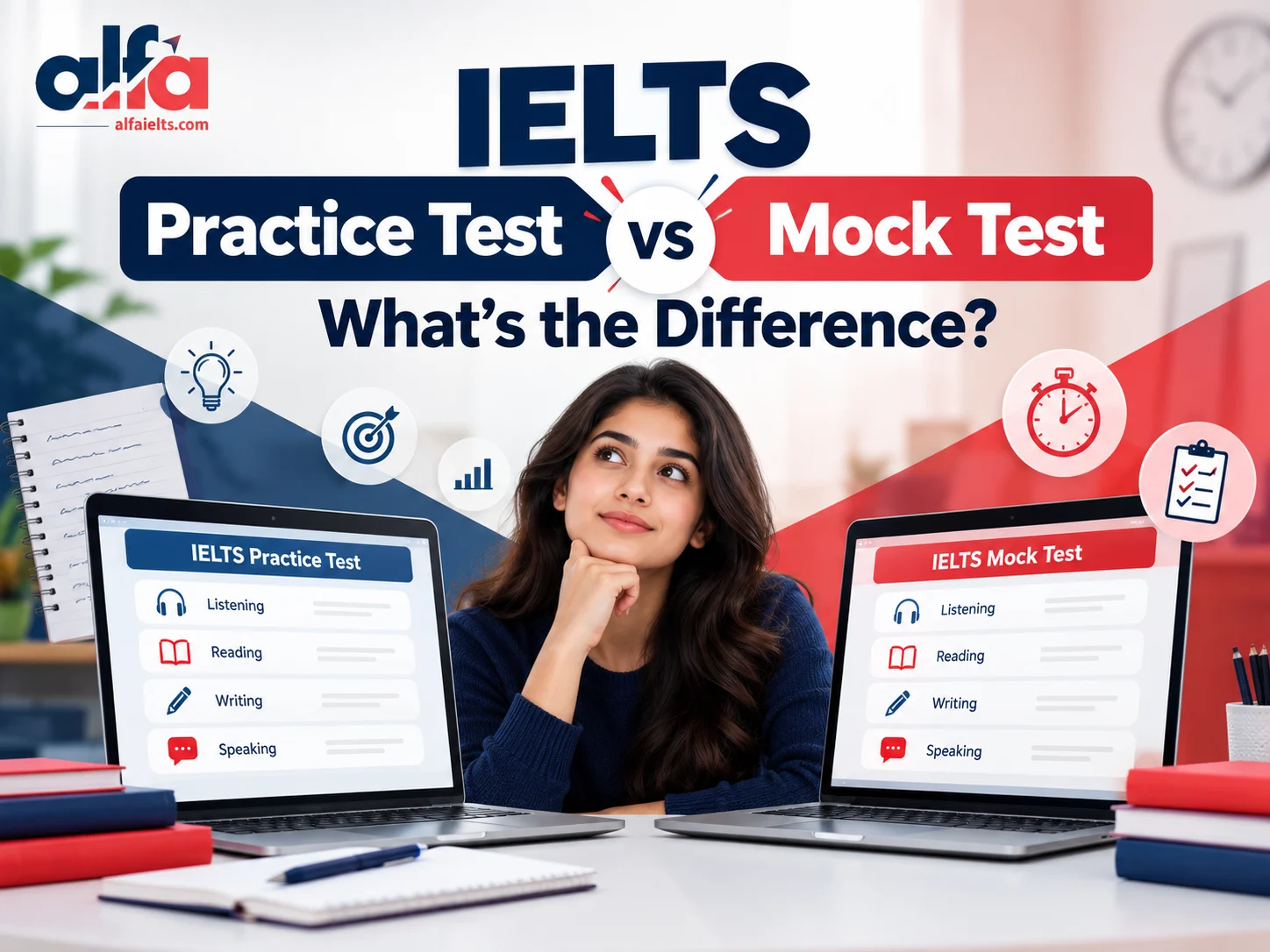
In general, a practice test is flexible and learning-oriented—you work on one skill or one type of question at a time. A mock test is essentially a full, timed simulation of the actual exam, used mainly to assess preparedness. These are not official IELTS categories, but a practical distinction that most preparation resources use.
Summarise blog with AI


IELTS Practice Test vs Mock Test: What’s the Difference?
- 14 min read

Last updated on 07 Oct 2026
Summarise blog with AI
"I have taken 5 IELTS practice tests. Is it really necessary to take a mock test?"
It's one of the most common questions students ask when they get serious about studying—and the short answer is the very beginning of the whole idea behind this guide: practice tests help you learn and improve. Mock tests are good to see how ready you are.
One qualification to note up front: these terms are not formally defined as two separate categories of the IELTS test. Preparation providers use 'practice test' and 'mock test' differently, but they are often used interchangeably. In this article, the term "practice test" is used mainly to refer to flexible, focused practice, whereas the term "mock test" is used to refer to a fuller simulation of the actual exam. IELTS itself provides sample test questions and practice materials to help familiarize candidates with the test format, task types, and timed conditions. It doesn't make the same sharp distinction that this article does, but the distinction is actually very helpful for planning your preparation.
Wondering Where You Stand? Take a Free IELTS practice test to find out your starting point
Practice NowWhat is an IELTS Practice Test?
In practical terms, an IELTS practice test is an exam style activity used to:
- learn the question types
- practice individual skills
- identify weaknesses
- develop strategy
- improve time
- check answers
- familiarize yourself with IELTS tasks
For example, a student might be doing 10 Reading questions, one Listening section, a single Writing Task 2, five Speaking Part 1 questions, one Speaking cue card, or a specific Reading question type they are struggling with.
Key idea: Practice tests are primarily learning tools
This is consistent with the overall approach to preparing for the IELTS – there are official sample materials, which can be used to help candidates understand the format and task types, and to practice under timed conditions, in the size suitable for the study session that day.
This is consistent with the overall approach to preparing for the IELTS – there are official sample materials, which can be used to help candidates understand the format and task types, and to practice under timed conditions, in the size suitable for the study session that day.
What Is an IELTS Mock Test?
A mock test is designed to copy the actual test. Typical features:
- Full or comprehensive
- Timer included
- Completed with minimal interruptions
- Follows the expected test structure
- Merges several sections or modules
- Aims to reproduce exam pressure
- Good for estimating readiness
Key idea: A mock test is mainly a diagnostic and simulation tool.
Alfa IELTS, for example, offers mock tests that simulate real-time exams, with realistic timing, full and sectional tests, and AI feedback and performance analytics.
Alfa IELTS, for example, offers mock tests that simulate real-time exams, with realistic timing, full and sectional tests, and AI feedback and performance analytics.
IELTS Practice Test vs Mock Test: A Quick Comparison
| FEATURE | PRACTICE TEST | MOCK TEST |
|---|---|---|
| Primary goal | Learning and improvement | Exam simulation |
| Length | Flexible | Generally complete/comprehensive |
| Timing | Timed or untimed | Strictly timed |
| Focus | Single skill | Multiple/ all sections |
| Pausing option | Often available | Ideally none |
| Feedback | Used to learn from mistakes | Used to evaluate performance |
| Frequency | Regular | Periodic |
| Difficulty | May vary widely | Comparable to exam level |
| Best stage | During preparation | After building core skills |
| Main question | "What do I need to improve?" | "Am I ready for the exam?" |
In particular, IELTS does not officially define practice tests and mock tests in different ways. This table illustrates a practical difference in preparation – how most students and tutors actually use these terms in day-to-day study, not the official classification of the IELTS.
Practice Test vs Mock Test: A Simple Illustration
Scenario A – Practice Test
You're having trouble with True/False/Not Given. You complete 15 questions. You check the answers. You analyse your mistakes. This is targeted practice.
Scenario B – Mock Test
You complete the test without interruption. You follow the timings and sit for a full IELTS simulation. That's practice for the mock test.
Practice test = workout. Mock test = match day.
You go to the gym to develop certain skills and fix certain weaknesses, one exercise at a time. Match day is where you learn how all that training holds up under real pressure, real time, with everything happening at once.
You go to the gym to develop certain skills and fix certain weaknesses, one exercise at a time. Match day is where you learn how all that training holds up under real pressure, real time, with everything happening at once.
Importance of Practice Tests for IELTS
Learn the Question Types
You get to know Multiple Choice, Matching Headings, True/False/Not Given, Note Completion, Sentence Completion, the Writing tasks and Speaking Parts 1–3 inside out through repeated, focused practice of the kind you can't get elsewhere.
Identify Weaknesses
This way of breaking down results changes uncertainty into a clear picture:
Reading: 29/40. Listening: 34/40. Writing: needs improvement. Speaking: vocabulary is strong but fluency is uneven.
The score itself is not the real value – it's what the score tells you to do next. A score without a plan is just a number.
Practice Strategies
Practice tests allow you to see if particular strategies actually work for you as an individual, for example skimming, scanning, paraphrasing, predicting, note-taking, structuring answers etc. It is much better to test these things than to assume a strategy will work because it worked for someone else.
Build Vocabulary and Grammar in Context
Practice exposes you to vocabulary in actual IELTS-style contexts, which works far better than memorizing isolated word lists.
Importance of Mock Tests for IELTS
Experience the Time Pressure
A mock test often reveals a very specific and important problem: "I know the answers but I run out of time." That's a totally different problem than not knowing the material, and it requires a totally different solution.
Build Stamina for the Test
Doing several sections in a row requires a kind of sustained concentration that isolated, short practice sessions just don't train for.
Time Management Test
Mock tests can reveal habits you didn't know you had – spending too long on certain Reading questions, writing too slowly in Task 2, not leaving enough time to review your Writing answers, losing concentration during Listening, or giving Speaking answers that are technically fine but too brief.
Build Readiness
Doing mocks regularly, rather than the one-off, allows you to see whether your performance is becoming more consistent over time — a one-off mock tells you where you are, repeated mocks tell you whether you're actually improving.
When Should You Take a Practice Test?
Your practice tests are part of your preparation—but they're not the whole point.
1
Beginning
Take a diagnostic test. Goal: to find your starting point.
2
Middle
Use targeted/sectional practice. Goal: to target specific weaknesses.
3
Final preparation
Mix practice with increasingly realistic simulations. Goal: To improve timing and consistency as test day approaches.
When Should You Take a Mock Test?
Instead of one fixed schedule, think in terms of stages:
1
Early stage
One initial mock to set a baseline.
2
Middle stage
Targeted practice with occasional mocks, checking your progress without over-testing.
3
Final stage
Increase realistic simulations as test date approaches.
4
Last week
Consistency, timing, familiarization and looking over mistakes, not just doing full back-to-back practice tests.
Alfa IELTS's very own 30-day study plan follows a similar progression: establish a baseline, build individual skills, move toward timed and full practice, and use mocks under realistic conditions closer to the exam.
How Many Practice Tests Should You Take for the IELTS?
There's no magic number here, and any article that gives you a specific number is guessing. What matters is what you do after every test.
Bad cycle
Test → Score → Forget
Better cycle
Test → Score → Analyse → Find weakness → Practice → Retest
This is the IELTS improvement cycle, and it's worth adopting as a circle rather than a one-time sequence – the value compounds each time you complete a full turn of it, not from the raw number of tests you have taken.
How Many Mock Tests Should You Take for the IELTS?
Again, there is no set number of mocks you need to take for IELTS. How many you need depends on your preparation time, current ability, target band, familiarity with the test format, specific weaknesses, and how consistent you already are with your scores.
Key message: Three well-analysed mocks are more useful than ten mocks that you just take and forget about.
Free IELTS Practice Tests and Paid Tests
Free tests
- Familiarization with the test format
- Basic practice
- Understanding the test format
- Trying out a platform before committing to it
Paid platforms
- Larger question banks
- Additional tests
- AI feedback
- Performance analytics
- Trainer assessment
- Progress tracking
- Practice targeted at specific weak areas
Free practice is a legitimate and useful starting point, but it tends to be less tailored to your specific gaps than a paid platform with feedback and analytics attached. Official IELTS itself offers free sample test questions and preparation resources.
IELTS Practice Test vs Mock Test for Each Module
Reading
- Practice: Concentrate on one question type.
- Mock: Do the full Reading test under the correct time conditions.
Alfa IELTS currently has available reading practice of multiple question types, timed full-length passages, and analysis of weaker question types.
Listening
- Practice: Work on individual skills such as spelling accuracy, prediction, completing notes, labelling maps, and multiple choice.
- Mock: Take a full Listening test as one continuous timed experience.
Alfa IELTS describes its Listening mock tests as based on the exam structure with 4 sections, realistic timing and automatic scoring.
Writing
- Practice: Work alone on Task 1 introductions and overviews, paragraph development, Task 2 introductions, examples, and conclusions.
- Mock: Finish both tasks in 60 minutes, the same amount of time as you would take on test day, one right after the other.
Alfa IELTS now offers Writing practice for Task 1 and Task 2 with AI feedback and criterion-based analysis.
IELTS Speaking Practice Test vs Speaking Mock Test
- Speaking practice could include going through one question, for example "What do you usually do at weekends?" and then focusing on vocabulary, fluency, pronunciation, grammar, and how well you develop your answer.
- Speaking mock is to do Part 1 → Part 2 → Part 3 in one go, as if you are in a real exam with an examiner, and with no pause between parts.
The official IELTS Speaking test has 3 parts and lasts 11-14 minutes. Part 1 is on familiar topics, Part 2 is a longer individual turn (based on a cue card) and Part 3 is a longer discussion based on the theme from Part 2.
Speaking practice asks
"How can I improve this specific answer?"
Speaking mock asks
"How do I perform in the whole Speaking test?"
How Alfa IELTS Helps You Practice IELTS Speaking
Alfa IELTS currently offers you the opportunity to practice Speaking Parts 1, 2 and 3 with AI-assisted evaluation and feedback. Its mock-test platform offers an AI examiner simulation, feedback on pronunciation and fluency, analysis of vocabulary and grammar, and prediction of band-score.
1
Practice Part 1
Practice familiar questions and develop natural answers, vocabulary, fluency, and confidence before moving on to harder material. Warm up your Speaking skills.
2
Practice Part 2
Work on idea generation, effective use of one-minute preparation time, full two-minute speaking, storytelling, and descriptive vocabulary.
3
Practice Part 3
Concentrate on opinions, causes and effects, comparisons, examples, and more abstract ideas.
4
AI Speaking Feedback
Alfa IELTS Speaking practice provides analyses of fluency, pronunciation, grammar and vocabulary, as well as AI-supported scoring and feedback. Speak. Ask for feedback. Discover your weak points. Try it again.
Begin your IELTS Speaking practice with Alfa IELTS.
Mock TestsHow to Analyse Your IELTS Mock or Practice Test
After every test, analyse these questions module-wise:
- Reading: What types of questions caused trouble? Did I run out of time? Did I misread any questions?
- Listening: Did I miss some answers because of spelling errors? Did I lose my focus at any point? Was there a problem with any particular accent?
- Writing: Did I answer the question fully? Did my structure make sense? Did I make the same grammar mistakes more than once?
- Speaking: Did I hesitate? Did I use the same language? Did I give too short answers? Did I explain my points? Did I have pronunciation problems that affected my clarity?
Common Mistakes Made by Learners
1
Taking daily mock tests
Testing doesn't fix weaknesses; you just do the same mistakes under a stopwatch without the analysis and targeted practice in between.
2
Looking at the score and stopping there
A score is only useful if it leads to action.
3
Not respecting time limits
This is especially damaging when a test is used to estimate real readiness – an untimed "mock" is no mock at all.
4
Stopping during a mock
Each pause makes it less valuable as a simulation of the real thing.
5
Repeating the same test
You risk memorizing answers instead of actually improving the underlying skill.
6
Ignoring feedback on speaking and writing
These skills require more than a right/wrong check - the real learning is in the feedback on structure, fluency, and use of language.
7
Treating each practice score as a guarantee of the final IELTS band
Online estimates are good indicators of where you are now, but not where you will end up with your official result.
Sample IELTS Practice Schedule for 7 Days
1
Day 1
Baseline practice test
2
Day 2
Reading + Listening weaknesses
3
Day 3
Writing practice
4
Day 4
Speaking Parts 1-3
5
Day 5
Targeted Sectional tests
6
Day 6
Complete mock test
7
Day 7
Error analysis + weak area practice
Also Read: IELTS Speaking Vocabulary: 200+ Words, Phrases and Expressions for Band 7+
FAQs
Q1. How Is an IELTS Practice Test Different From a Mock Test?
Q2. When Should I Take a Mock IELTS Test?
An early mock can set a baseline, occasional mocks throughout the course of your preparation can help you track your progress, and more frequent mocks closer to your test date can help you build consistency and timing under realistic conditions.
Q3. How Many Mock IELTS Tests Do I Need to Take?
There is no official number. It depends on your preparation time, current ability and target band – a small number of mocks that you properly analyse tend to be more valuable than many mocks taken without review.
Q4. Are IELTS Mock Tests Accurate?
Well-designed mock tests can provide a useful indication of level and readiness. But they are indicators, not guarantees of what your final official band score will be.
Q5. Can a Mock Test Predict My IELTS Band Score?
It can give you a prediction based on how you did in an exam situation, but the real exam will be marked by real people (Speaking and Writing) and will go through certain processes for scoring. So, any 'predicted' score should be considered as a helpful guide rather than a guarantee.
Q6. Are Free IELTS Practice Tests Helpful?
Yes, especially for familiarizing with the test format and basic skill building. Also, paid platforms usually offer more detailed feedback, more questions in the bank, and analytics on performance.
Q7. Should I Take a Full IELTS Mock Test Every Day?
No. Testing daily without reviewing mistakes and practicing weaknesses in-between rarely helps in reducing existing errors. Well-reviewed periodic mocks are more effective.
Q8. What Should I Do After Taking an IELTS Practice Test?
Review your answers, figure out the exact reasons behind every mistake, record the recurring problems, and practice the weak spots directly before retesting.
Q9. How Can I Prepare for IELTS Speaking at Home?
You can record yourself answering typical questions for Parts 1, 2 and 3, and review your fluency and vocabulary. You can also use a platform with AI-supported Speaking practice and feedback like Alfa IELTS.
Q10. How Can Alfa IELTS Help Me in IELTS Preparation?
Alfa IELTS offers practice-style and mock-style preparation for Reading, Listening, Writing and Speaking. This includes sectional tests, full-length mocks, timed conditions, AI feedback, and performance analysis to help you identify and target specific weaknesses.

Ram Prasad Sharma
Author

Tags:
Share: