IELTS Academic Reading Diagram Label Completion: Tips, Examples & Practice
- 32 min read

Why Diagram Labelling can be Confusing
A candidate reads a passage about a machine and understands it well. The basic idea is clear: Water comes in, something happens to it, and something comes out. Then comes the diagram, with five numbered gaps and five pointer lines. Suddenly, the candidate can name every part in the passage, but cannot decide which part goes into gap 3.
This is the main difficulty of ELTS Diagram Label Completion. It is not a pure reading task. It is not a pure picture task. It integrates three skills:
- Reading comprehension: Identifying what the passage says about each element.
- Visual interpretation: Reading the arrows, pointers, boundaries and layout in diagrams.
- Exact answer selection: Writing the exact word or words used in the passage, within the specified word limit.
In this guide, you will find:
- the task format,
- the types of diagrams you may encounter,
- a step-by-step strategy built around the framework INSPECT → LOCATE → MATCH → VERIFY,
- a section on the spatial language that diagram descriptions rely on,
- a fully worked example with original artwork,
- a table of common mistakes,
- three graded practice sets with diagrams and explanations,
- time-management advice, and
- a home training plan and a 7-day schedule.
What Is IELTS Academic Reading Diagram Label Completion?
Diagram Label Completion question requires you to complete missing labels on a diagram using information from a reading passage. The passage is a verbal description of an object, structure, or process. It is shown visually in the diagram. Your job is to link the description with the visual.
What does the question look like?
A typical task consists of four components:
- A passage explaining an object, structure or process.
- A diagram with numbered gaps and arrows or pointer lines.
- Instructions specifying the answer length, such as "Choose NO MORE THAN TWO WORDS from the passage for each answer."
- Labels that you are required to complete accurately, using words from the passage.
Some diagrams have no labels at all except for numbered blanks. Some are partially completed, with some labels already printed. Those printed labels are not decoration. They give you fixed points on the diagram to help you work out where the missing parts are.
What Skills Does Diagram Labelling Test?
- Detailed understanding: knowing exactly what is said in each sentence about a component.
- Scanning: quickly finding the relevant part of the passage.
- Visual interpretation: reading what the diagram shows and what its arrows mean.
- Understanding spatial relationships: understanding words like above, beneath, adjacent to, or passes through.
- Matching a written description with the correct part of a diagram: the skill that makes this task different from the others.
Are the Answers in the Same Order as the Passage?
Not necessarily. The label numbers follow the layout of the diagram, not the order of the passage. For example, in the practice sets below, the labels are numbered in the order they appear on the picture, but the passage refers to the components in a different order.
So don't assume that Label 1 is described first, or that the passage flows nicely from Label 1 to Label 2 to Label 3. Refer to the features in the diagram and descriptions in the passage to help you find each answer.
What Types of Diagrams Appear in IELTS Reading?
You cannot assume that IELTS will give you a particular category of diagram. The following is a list of the kinds of diagrams commonly given, not a forecast of what you will get in the test.
- Examples: wind turbines, water pumps and mechanical systems.
- These diagrams typically label parts that are connected in sequence (a shaft turns a gearbox that drives a generator). The passage describes the function of the machine in a step-by-step manner.
- Examples: flower parts, plant structures, animal anatomy.
- There are many parts close together and looking similar (two kinds of tube inside the same stem, for example). They are often identified in the passage by their function or position, not by their looks.
- Examples: greenhouses, ventilation systems, construction features.
- These diagrams often have components arranged along a path, such as the path air takes through a building. The order of the passage may be different from the order on the page.
- Examples: water filtration, irrigation, energy conversion.
- These diagrams are a combination of physical components and arrows showing movement. The skill is to differentiate between a part and a flow.
Why Understanding the Diagram is Important
A diagram is a bundle of clues. Before you read the passage in detail, note:
- Arrows: do they indicate the flow of something (water, air, electricity), or do they point to a part?
- Pointers: where does each pointer line end exactly? The dot or arrowhead indicates the component, not the general area of the label.
- Labels already printed: these anchor the layout and may appear in the text as hints.
- Boundaries and enclosures: a box, an outline or a tank wall tells you what is in and what is out.
- Spatial arrangement: which parts are above, below, in front of, behind, beside or between which other parts.
A reader who studies these features first knows what information is missing before opening the passage. That makes the search quicker and the answers more accurate.
Step by Step Methods to Solve Diagram Labelling Questions
This is the heart of the guide. Use the following framework:
This is a suggested learning framework, and is not an official IELTS formula.
- INSPECT the directions and the diagram.
- LOCATE the part of the passage that describes it.
- MATCH the written description with the correct visual feature.
- VERIFY the wording, the word limit, and the position.
These seven steps put the four actions in order.
- Find the maximum number of words or numbers allowed.
- See if the question requires you to use words from the passage.
- Look for numbered blanks or partially filled-in labels on the diagram.
Example: Instruction: Choose NO MORE THAN TWO WORDS from the passage. An answer of "the vertical pipe" has three words, and would lose the mark although the idea is correct.
- Understand what the diagram is showing (wind turbine, plant, greenhouse).
- Notice the parts that are labelled and those that are not.
- Look at arrows, flow direction and relative locations.
- Predict the type of information you will need. Is each gap a part name, function, or a material?
Example: In the rainwater diagram further down this article, you can see at a glance how the system runs from a roof to a tank. One can guess even without reading that the gaps will be such parts as a gutter, a pipe, a filter, a tank, and a tap.
- Use surrounding features and existing labels as hints for searching.
- Look for words like beneath, above, next to, inside, though, or connected to.
Note: Descriptions may be worded differently from the diagram.
Example: If a diagram has a box labelled "Nacelle" in print, then the sentence in the passage that uses the term "nacelle" is probably describing what is inside or on top of the nacelle.
- Scroll down to the section that describes what the diagram is about.
- Search for component names, functions, or location clues.
- When the information is all in one place, don't re-read the whole passage again and again.
Note: For diagram tasks, the relevant information is often found in one paragraph or one run of sentences, because the writer is describing one object or one process. Find that stretch, and work your way out of it.
- Locate the pointer or arrow and follow it to the exact location.
- Search the passage for a description of where or how that component works.
- Identify similar-looking parts.
Example: A stem diagram shows three tubes lined up. The passage says that one 'runs up the centre of the stem' and carries water and others lie 'beside' it and carry sugars. The pointer ending in the middle tube must be the water tube. The position clarifies what the appearance cannot.
- Accurately copy the relevant wording.
- Do not substitute technical terms with your own synonyms.
- Make sure the answer fits the label and the instructions.
Example: If the passage says "mesh filter", write mesh filter, NOT "strainer" or "screen". The task requires you to write the passage words.
- Recheck precisely what the pointer is saying.
- Confirm that the answer does not exceed the word limit.
- Check the spelling and whether the answer fits grammatically with the label.
Note: Verification takes seconds, and rescues marks that would otherwise be lost to a misspelling, an extra word or a pointer misread.
IELTS Diagram Labelling: Understanding Spatial Language
Words that locate things in space are very important in diagram descriptions. Here is where many otherwise good readers lose marks, for one preposition can change one element into another.
| Spatial Expression | Meaning in a Diagram |
|---|---|
| Above/Below | Higher or lower position |
| Inside/ Outside | Within or beyond a structure |
| Adjacent to/ Next to | Located beside something |
| At the base of | At the bottom of a structure |
| Attached to | Connect to another component |
| Surrounded by | Enclosed/covered by something |
| Passes through | Moves through an opening or structure |
| Leads into | Connects or directs something into another part |
| Beneath the surface | Located below the outer layer |
| Between | In the middle of two features |
Why Prepositions Matter
If you get confused between above and below or inside and outside, you can be directed to the wrong component.
Example: A passage states, "A collection tank sits beneath the condenser." A reader who reads beneath as beside may place the answer on a box on the side of the condenser instead of the one below it. Both pictures contain the same two components. Only the preposition determines which pointer belongs to which word.
Following Arrows and Direction
Diagrams use two kinds of lines, and they mean different things.
- A pointer (a line ending in a dot, or a simple line from a label) identifies a physical part.
- A flow arrow indicates the direction of movement (water, air, electricity or a product).
Example: If a flow arrow runs from the filter to the tank, it tells you the order of the process. It doesn't tell you that the arrow itself is a "pipe". Only the pointer line labels a part.
IELTS Reading Diagram Label Completion with Answers
This is the strongest teaching section of the guide. Work through the passage and diagram first, then read the explanations.
Passage: How a Simple Rainwater Harvesting System Works
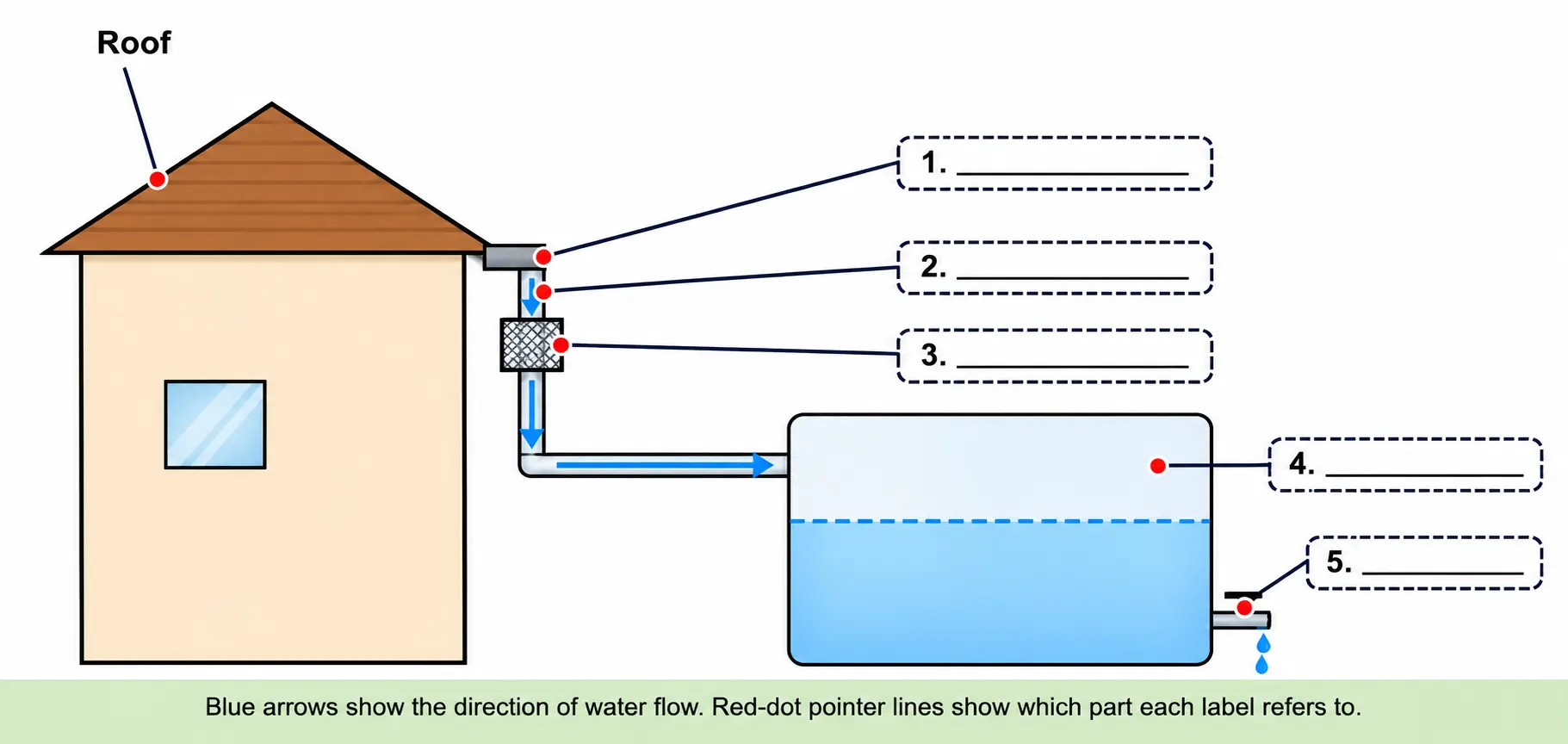
A simple rainwater harvesting system collects rain water from the roof of a structure. Rainwater runs along the gutter and down a vertical pipe. Then it goes through a mesh filter which filters out leaves and other big pieces. The filtered water is then pumped to a storage tank through a horizontal pipe and held until needed. The stored water can be drawn from a tap near the bottom of the tank by users.
Questions 1–5. Label the diagram. Choose NO MORE THAN TWO WORDS from the passage for each answer.
Label 1: Gutter
Label 2: Vertical pipe
Label 3: Mesh filter
Label 4: Storage tank
Label 5: Tap
How To Get Each Answer
Label 1 & 2: Gutter/ Vertical pipe.
Passage phrase: "Rainwater runs along the gutter and down a vertical pipe."
Pointer position: the pointer stops at the small channel at the edge of the roof where the water first collects. The pointer is on the vertical section of pipe between the gutter and the hatched box.
Why it's a match: It begins with collecting water from the roof and the gutter is the first thing it speaks about. The diagram's printed label "Roof" confirms that the pointer is at the edge of the roof. The vertical pipe is immediately after the gutter and before the filter in the sentence. The passage never names the horizontal pipe that leads into the tank, so it cannot be the answer.
Label 3: Mesh filter
Passage phrase: "Then it goes through a mesh filter which filters out leaves and other big pieces."
Pointer position: The pointer ends at the hatched box embedded in the pipe.
Why it's a match: The function in the passage (removing leaves and large particles) is a filter. The place it occupies in the sequence is also right: then it goes through, after the vertical pipe and before the tank.
Label 4: Storage tank
Passage phrase: "The filtered water is then pumped to a storage tank through a horizontal pipe and held until needed."
Pointer position: The pointer is inside the large container on the right, above the water level.
Why it's a match: The passage describes the tank by name, and by function (held until needed). The pointer hits the container as a whole, not the water inside it.
Label 5: Tap
Passage phrase: "The stored water can be drawn from a tap near the bottom of the tank by users."
Pointer position: The pointer should end up on the small fitting on the bottom right of the tank.
Why it's a match: It has a spatial clue, near the bottom of the tank, and a functional clue, allows users to draw. Both agree with the diagram.
What Can You Learn from this Example?
The most reliable way is to combine four things: reading the diagram, scanning, spatial clues and careful checking. None of them individually would have solved all the labels.
Position and function are one and the same. Both the hatching and the passage's description of what the part does confirmed label 3.
The passage frequently follows the physical route. Here the sequence of the sentences follows the movement of the water, which makes the diagram easier to read.
Pointers define what a label means. In a real diagram, several parts may be described by the same word, but the dot at the end of the pointer determines which.
Word limits are part of the answer. All of the above answers satisfy the limit. All of them use the wording from the passage itself.
Common Mistakes in IELTS Reading Diagram Labelling
| Common Mistake | Why it Causes Problems | Better Approach |
|---|---|---|
| Ignoring the word limit | Even right answer loses mark | Check instructions before answering |
| Assuming answers appear in numerical order | Diagram labels do not always match passage order | Follow both the description and diagram |
| Confusing adjacent components | Nearby parts may look alike | Follow each pointer carefully |
| Relying only on keywords | The keyword could be about another feature | Pay attention to function and location |
| Ignoring prepositions | Prepositions change the components' locations | Read spatial descriptions carefully |
| Guessing from general knowledge | Answer words have to be from the passage | Use textual evidence |
| Adding unnecessary words | This may exceed allowed answer length | Select only the required words |
| Failing to check spelling | It can make even correct answer wrong | Check answer against the passage |
Brief Illustrations of the Most Expensive Mistakes
The passage says, "Cables carry electricity down through the tower." A candidate sees the word tower and writes it in a gap that points at a box at the bottom of the tower. But the sentence continues by saying that the cables go to a transformer at its base. The keyword (tower) was a signpost to the right sentence, not the answer.
A gap points to the box between a shaft and a generator. A candidate who knows that wind turbines "often have a gearbox" writes 'gearbox' without checking. The knowledge is correct this time, but it might be on another diagram. Only the passage can confirm the answer, and the exact wording matters.
The passage says "a storage tank" and the candidate writes "the storage tank". The extra word costs them the mark, because the limit is two words.
Diagram Label Completion vs. Other Completion Task Types
Labelling diagrams is one type of completion task, but the way the diagram is presented changes how you search.
| Question Type | What Candidates Complete | Main Focus |
|---|---|---|
| Diagram Label Completion | Missing labels on a visual diagram | Linking text to graphics |
| Flow-chart Completion | Missing information in a sequence | Understanding steps and relationships |
| Table Completion | Incomplete information in rows and columns | Finding and categorizing details |
| Summary Completion | Missing words in a summarized paragraph | Understanding the meaning of a section |
| Sentence Completion | Missing words in sentences | Locating specific information and maintaining grammatical sense |
Diagram Labelling vs Flowchart Completion
A diagram usually labels elements or aspects of a graphical representation. A flow chart shows stages or connections in a sequence.
Example: In a diagram of a water system, a gap labels a thing (a filter). In a flow-chart of the same system, the gap is a step ("water is filtered") in a sequence of boxes linked by arrows. The first is to ask what this part is called. The second is to ask what happens next.
Why the Distinction Matters
Different task layouts require different search strategies. Check the visual structure before you decide how to locate the information.
- For a diagram, look for component names, functions, and location clues.
- For a flow chart, look for sequence words like first, then, after and finally.
- For a table, use the column and row headers to identify what you are looking for.
IELTS Reading Diagram Label Completion: Practice Questions
Test each set out on yourself before reading the explanations. All passages, questions and diagrams are original practice materials.
Practice Set 1: Introductory
Focus: component names, spatial clues, and exact word matching. Four labels.
How a Wind Turbine Works
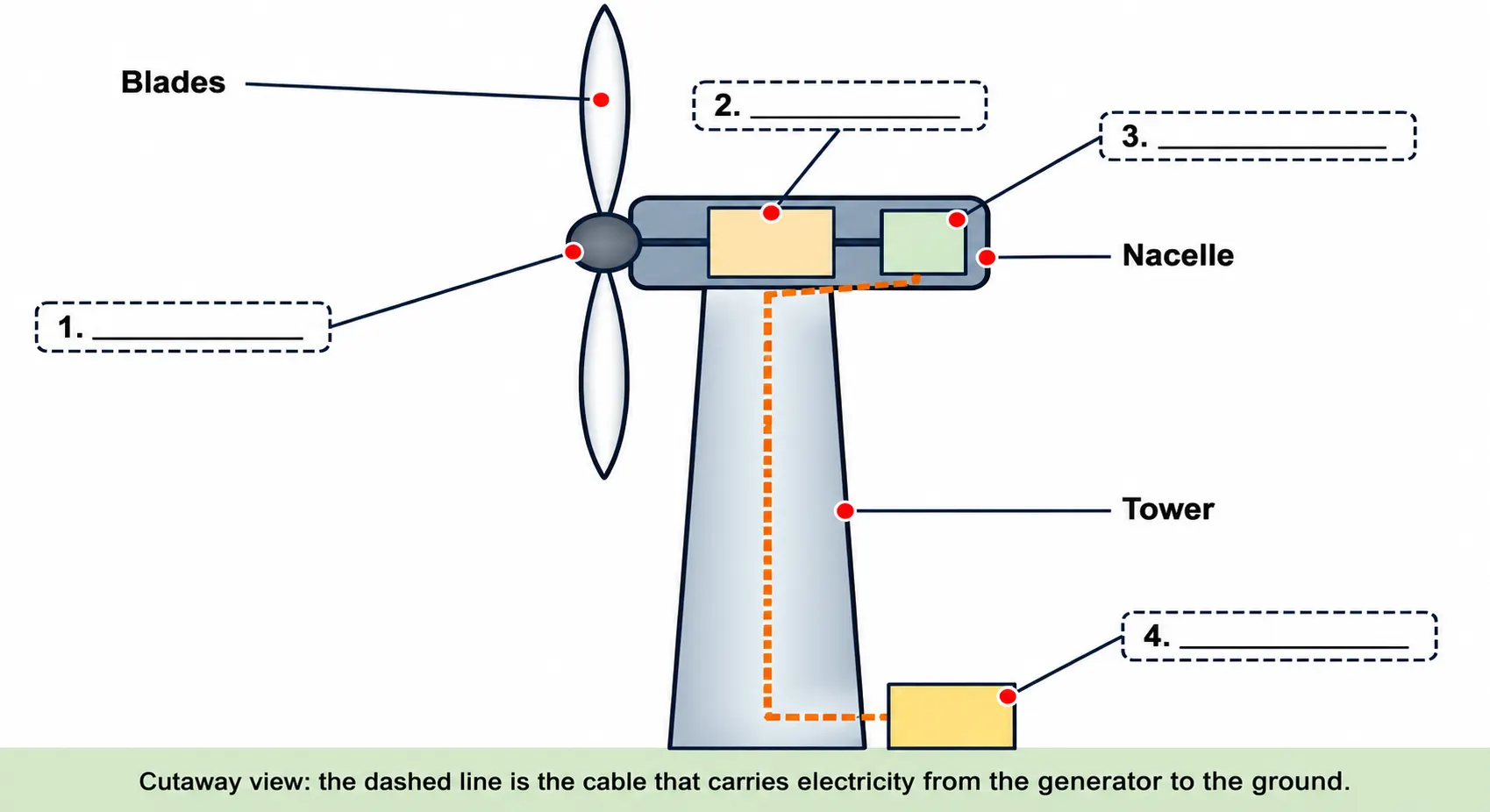
Modern wind turbines use the movement of air to generate electricity. And it does so without burning any fuel. Long blades are attached to a central hub, together forming the rotor. The wind hits the blades and the rotor turns slowly. The hub connects to a shaft that extends into the nacelle, a housing on top of the tower. The nacelle houses a gearbox which speeds up the rotation rate before it reaches the generator that generates the electricity. This electricity is carried down the tower through cables, to a transformer at the base, which prepares it for the power grid. The tower itself is typically a tapered steel cylinder, wider at the bottom than the top, because it has to support the weight of the nacelle and withstand high winds. The nacelle has sensors to measure wind speed and direction, and a small motor that turns the entire nacelle so that the rotor is always facing into the wind.
Questions 1-4: Label the diagram. Answer each question with ONE WORD ONLY from the passage.
Practice Set 1 — Wind Turbine
1. hub
Evidence: "Long blades are attached to a central hub"
Pointer: The dark disk in the centre where the blades come together.
WHY: The passage states the blades are attached to a central hub. The tempting wrong answer is rotor, but the passage states that the blades and hub together constitute the rotor, meaning the rotor is a larger assembly than just the disk.
2. gearbox
Evidence: "The nacelle houses a gearbox which speeds up the rotation rate before it reaches the generator"
Pointer: The box on the shaft between the hub and the second box.
WHY: The sentence provides the sequence: shaft, then gearbox, then generator. The first box after the shaft is the gearbox. Shaft is a distraction. It's the line, not the box.
3. generator
Evidence: "...before it reaches the generator that generates the electricity."
Pointer: The box at the outer end of the chain, from which the cable leaves.
WHY: This is the next thing in line after the gearbox and this is where the cable (that carries electricity) begins. Sequence and function match.
4. transformer
Evidence: "This electricity is carried down the tower through cables, to a transformer at the base."
Pointer: The box on the ground right beside the tower's base.
WHY: Because of the spatial clue at its base. Cables, sensors, and motor are all in the passage, but describe other things.
Practice Set 2: (Intermediate)
Focus: identifying components by their functions and relationships. Five labels.
Movement of Water in a Plant
Water flows in an unbroken stream from the soil through a plant to the air. The trip starts at the root hairs. These are tiny projections of the root surface that absorb water and dissolved minerals from the soil. The water then moves through the cortex, a layer of loosely packed cells in the middle of the root, until it reaches the xylem. Xylem is a system of narrow tubes that run up the middle of the stem. It carries water to all parts of the plant. The phloem tubes, which carry the sugars produced in the leaves to the rest of the plant, are next to the xylem but do not help to lift the water up.
In the leaves, the xylem branches into fine veins that carry water to the leaf tissue. The water then evaporates from the leaf through the stomata, small pores on the underside of the leaf. Each pore is surrounded by two guard cells, which open and close the pore according to how much water the plant can afford to lose. This is called transpiration pull. Water evaporating from the stomata pulls more water up through the xylem. The cells lose their firmness without water, so without this constant supply leaves would wilt.
Questions 1-5: Label the diagram. Answer each question with NO MORE THAN TWO WORDS from the passage.
Practice Set 2 — Movement of Water in a Plant
1. stomata
Evidence: "The water then evaporates from the leaf through the stomata, small pores on the underside of the leaf."
Pointer: The pore in the magnified view of the underside of the leaf.
WHY: The pointer ends on a pore. The word for the pores of the passage is stomata. The answer is worded in the passage, but one pore is pointed to.
2. guard cells
Evidence: "Each pore is surrounded by two guard cells, which open and close..."
Pointer: One of two cells on each side of a pore.
WHY: 'Surrounded by' is the spatial clue and 'open and close' is the functional clue. The two cells are on each side of the gap.
3. xylem
Evidence: "Xylem is a system of narrow tubes that run up the middle of the stem. It carries water…"
Pointer: The central tube of the stem.
WHY: This is the best example of a match of position with function. The passage says: middle, carries water.
4. phloem
Evidence: "The phloem tubes, which carry the sugars produced in the leaves to the rest of the plant, are next to the xylem.."
Pointer: A narrower tube at the side of the stem.
WHY: Next to the xylem means away from the centre. The two tubes look similar, so labels 3 and 4 can only be distinguished by their positions and functions.
5. root hairs
Evidence: "The trip starts at the root hairs. These are tiny projections of the root surface that absorb water…"
Pointer: The thin things that come out of the roots below the soil line.
WHY: Fits the picture of small extensions of the root surface. The passage includes the cortex and veins, but mentions parts that are not labelled on the diagram.
Practice Set 3: Challenging
Focus: Complex descriptions, multiple interrelated components, and labels not in order of passage. Six labels.
A Greenhouse that Grows Crops Using Seawater.
Seawater greenhouse is a structure designed to be built in dry coastal regions, where sunshine is abundant, but fresh water is scarce. Its goal is to grow crops using only seawater, sunlight and normal air. At the front of the building, an intake pipe draws seawater from the shore through a low-pressure pump that discharges the seawater at the top of the evaporator wall. It's a tall screen of porous panels, and the water drips slowly down it. The wind blowing through the wall picks up moisture and the evaporation cools the air a couple of degrees. The seawater that does not evaporate gathers into a shallow brine channel at the foot of the wall and flows back to the sea. The cool, moist air then enters the growing area, a long room with crop beds on each side of a central walkway. Plants lose less water and require little irrigation because the air is cooler and more humid than the air outside. At the far end of the growing area the air is forced through a second set of screens. Behind them comes the condenser, a line of upright pipes through which runs cold sea water pumped up from the intake pipe. The warm and moist air meets the cold pipes. The water vapor condenses into droplets. They fall down into a collection tank below the condenser. Any excess fresh water is then pumped out to the crop beds and stored for drinking. It needs very little electricity to run its pumps, and solar panels can provide that. Air remaining in the system escapes through a vent in the back wall.
Questions 1-6: Label the diagram. Answer each question with NO MORE THAN TWO WORDS from the passage.
Practice Set 3 — Seawater Greenhouse
1. Collection tank
Evidence: "The water vapor condenses into droplets. They fall down into a collection tank below the condenser."
WHY: Spatial clue is 'below the condenser'. 'They fall into' describes what the tank gets. Condenser is the tempting mistake, because the tank sits under it.
Evidence: " discharges the seawater at the top of the evaporator wall. It's a tall screen of porous panels, and.."
Pointer: the perforated dotted panel on the front of the building.
WHY: The wall is at the front of the building, and a tall screen of porous panels matches the dot texture. Do not confuse it with the second set of screens, which the passage places at the far end of the growing area.
Evidence: "The cool, moist air then enters the growing area, a long room with crop beds on each side..."
Pointer: The dashed line outlining the entire chamber.
WHY: The outline depicts an area, not a singular object. Crop beds is a distractor: the beds are within the growing area, but the label is for the whole chamber.
Evidence: "At the front of the building, an intake pipe draws seawater from the shore through a low-pressure pump that discharges the seawater e."
Pointer: The pipe coming up from the pump by the sea.
WHY: The pipe starts at the shore pump and also supplies the condenser further down the passage. The pointer points at the same tube.
Evidence: "The seawater that does not evaporate gathers into a shallow brine channel at the foot of the wall..."
Pointer: The small channel at the foot (bottom) of the porous wall.
WHY: The spatial clue at the foot of the wall, and 'gathers'... describes its function. The short line which leads to the sea confirms it.
Evidence: "Behind them comes the condenser, a line of upright pipes through which runs cold sea water.."
Pointer: One of the vertical (upright) pipes at the rear of the building.
WHY: The picture matches a row of vertical pipes. It places them behind the second set of screens.
Time Management Tips for Diagram Labelling
IELTS Academic Reading gives 60 minutes for 40 questions. There is no official time limit on each diagram-labelling question, so regard the tips below as habits rather than rules.
Before you search the passage, look at the diagram and the instructions. A quick look tells you what kind of information is missing.
Just find the part you need. Don't keep reading the whole thing over and over. Diagram descriptions are generally centred in one place.
Use labelled parts as clues to locate missing components. A printed label is a ready-made search term.
Don't spend too much time on one tricky label. Mark it, move on, and come back.
If it helps to find relationships between parts, begin by labelling the easy ones.
First, practice accuracy, then develop speed with timed exercises. Speed built on weak accuracy doesn't usually last.
How to develop IELTS diagram labelling skills at home
Exercise 1: Practice spatial vocabulary
Practice describing positions and relationships orally using simple diagrams (an appliance manual, a bicycle, the rainwater diagram above).
Example sentences: "The filter is between the vertical pipe and the tank." "The tap is near the bottom of the tank." "The gutter is attached to the edge of the roof."
Exercise 2: Match the parts to the descriptions
You have a diagram with labels. Find a study partner (or use your own notes) to give you descriptions without saying the name of the part. Identify each of the components from the description only.
Example: It takes out the big particles before the water gets to the tank → mesh filter.
Exercise 3: Practice Paraphrase Identification
Turn to the diagram and see how the visual clues compare with the differently worded descriptions in the passage.
Example: A picture shows a hatched box. The text reads 'a mesh filter that removes leaves'. The hatching is a visual cue for mesh, and the verb removes is in keeping with the idea of filtering.
Exercise 4. Practice timed diagram completion
Practice efficient evidence gathering with a realistic question set. Record the time and your accuracy.
Exercise 5: Maintain an Error Log
Note if the mistake was an issue of location, word limits, spelling, paraphrasing, component confusion, or time management.
| Question Label | Mistake Type | What to Check |
|---|---|---|
| Label 3 | Component confusion | Check the pointer's end before deciding |
| Label 5 | Word limit | Count words before finalizing |
| Label 2 | Spelling | Copy spelling exactly from the passage |
IELTS Diagram Labelling Practice Plan: 7 Days
| Day | Area of Focus | Suggested Activity |
|---|---|---|
| 1 | Understanding the task | Study the format and complete a short example |
| 2 | Spatial language | Practice 15-20 location and relationship expressions |
| 3 | Diagram interpretation | Identify components only with visual clues |
| 4 | Scanning | Locate descriptions of objects and functions |
| 5 | Answer accuracy | Complete diagrams and check word limits |
| 6 | Timed practice | Take a Reading sectional test |
| 7 | Error review | Analyse mistakes and repeat weaker tasks |
How Alfa IELTS Helps with IELTS Reading Practice
Diagram labelling is one skill in a comprehensive IELTS Practice Test. Alfa IELTS offers Academic Reading practice, sectional and full IELTS mock test, timed passages, instant scoring and performance analytics. Its mock-test page also includes AI-powered analysis of weaker Reading question types.
Practice with IELTS Style Reading Tests
You need to match visual information to descriptions in the passage to label diagrams. Working on other question types in Reading will help you get used to what the full test demands, where you switch between types of tasks all the time.
Increase Accuracy with Timed Tests
Timed Reading practice helps you to apply the INSPECT, LOCATE, MATCH and VERIFY technique under realistic time pressure. Start untimed to build accuracy, and then add the clock.
Identifying Weaker Reading Question Types
Use performance data to see if you need more time on completion tasks, matching questions or other Reading skills. Then use the above error log to figure out why: whether it is location, wording, spelling or time.
Mock Tests practice (Sectional & Full)
If you take a sectional test, you can focus on Reading only and work on your weaknesses. A full mock test allows you to experience the whole test, including managing your energy and time across the four sections. Sectional tests are for when you're developing a skill. Full mocks are for finding out if the skill stands up under test conditions.
Follow a Disciplined Routine of Improvement
Learn → Practice → Review → Improve → Repeat
Learn the method from a guide like this one.
Practice untimed questions until you're consistently accurate.
Review each mistake and each lucky guess.
Improve the specific weakness you found.
Repeat with a new set, and slowly increase the time pressure.
Diagram Label Completion: A Quick Checklist
- Have I read the instructions and word limit?
- Did I look at the subject of the diagram, the arrows and the printed labels?
- Do I know where each pointer points?
- Did I find the part of the passage that describes the diagram?
- Have I used spatial and functional clues and not only keywords?
- Is my answer contained in the paragraph, in the passage's words?
- Is my answer within the word limit and is it spelled correctly?
- Did I check the answer against the exact component the pointer indicates?
Conclusion
Labelling of diagrams needs a calm repeatable method. Inspect the diagram before the passage. Locate the section that describes this. Match each description to the exact component the arrow is pointing to, using position and function. Verify word limit and spelling.
Practice on different diagrams, honestly evaluate your mistakes, and introduce time pressure only if your accuracy is stable.
Also Read: Skimming and Scanning in IELTS Reading: What's the Difference?
Begin Your IELTS Reading Practice with Alfa IELTS
Mock TestsFAQs
Q1. What is Diagram Label Completion in IELTS Reading?
Q2. How Do I Answer Diagram Labelling Questions?
Q3. Are Diagram Label Answers in the Same Order as the Passage?
Q4. Can I Use My Own Words to Label the Diagrams?
Q5. Why Are Spatial Words Important in Diagram Labelling?
Q6. Is Flow Chart Completion the Same as Labelling Diagrams?
Q7. How Can I Improve Diagram Labelling Skills at Home?
Q8. Where Can I Practice IELTS Reading Online?