Summarise blog with AI


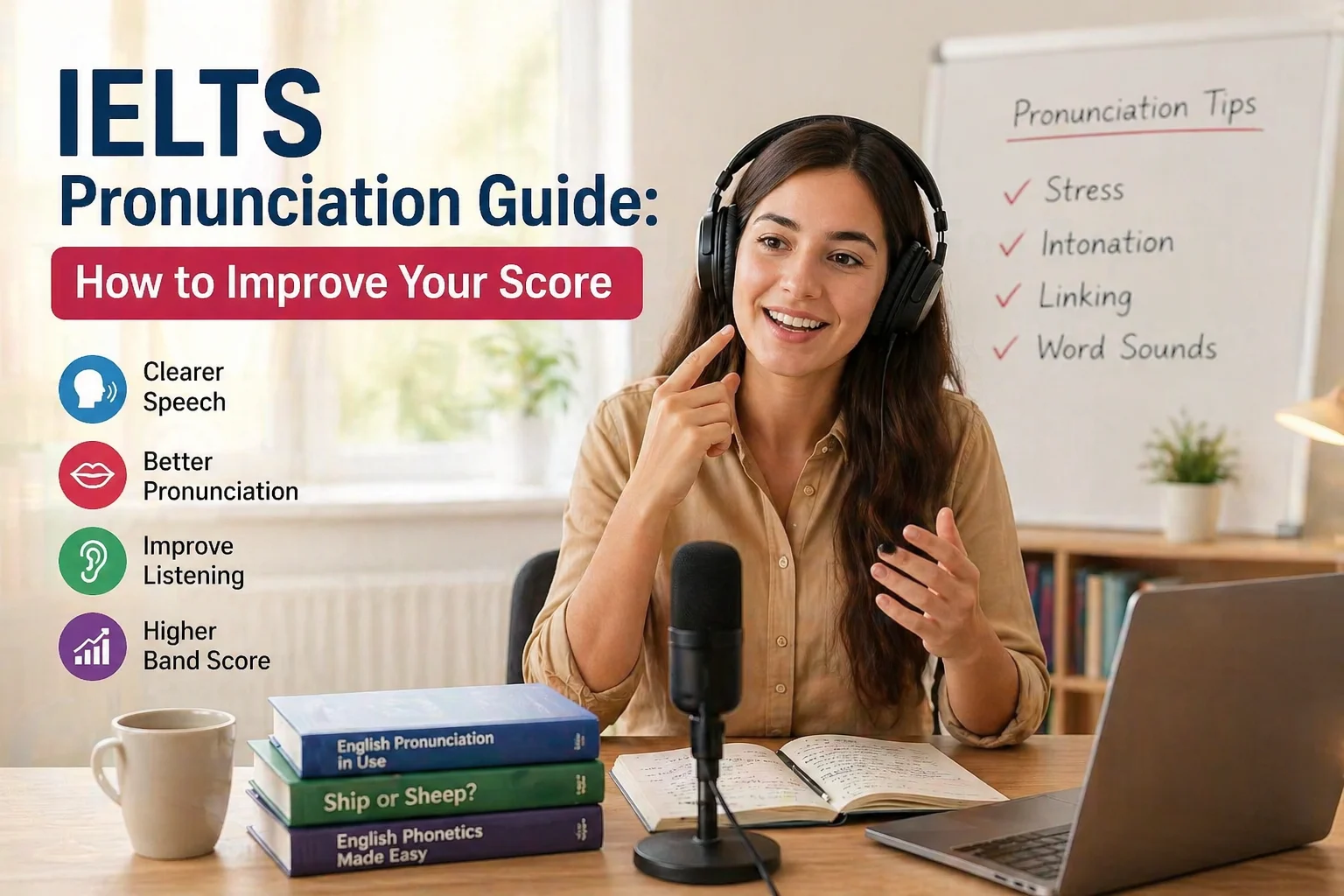
IELTS Pronunciation Guide: How to Improve Your Score
- 10 min read

Last updated on 24 Apr 2026
Summarise blog with AI
Key Takeaways
- Pronunciation is one of the four key IELTS Speaking scoring criteria, along with fluency, vocabulary, and grammar.
- Examiners focus on clarity, stress, intonation, and connected speech, not your accent.
- Good pronunciation includes correct sounds, natural rhythm, and clear word stress.
- Common mistakes include mother-tongue influence, wrong stress patterns, flat tone, and speaking too fast.
- Practicing minimal pairs, shadowing native speakers, and recording yourself can significantly improve pronunciation.
- Daily speaking practice and using tools like ELSA Speak, BBC Learning English, and podcasts help build fluency and confidence.
- With consistent practice and awareness of pronunciation patterns, Indian students can easily achieve Band 7+ in IELTS Speaking.
What is IELTS Pronunciation?
OK, much has been written and discussed about pronunciation in the IELTS Speaking test, and the term gives nervous feelings to the majority of test takers. However, when you understand pronunciation properly, much of the fear is sure to vanish.
In the IELTS Speaking test, pronunciation simply means how clearly and correctly you speak English so the listener (here, the examiner) can understand you.
The good news is that it is not about sounding like a British, American, or Australian. Instead, it focuses on:
- Clear speech
- Correct sounds
- Natural rhythm and tone
As pronunciation is one of the four key criteria of assessment in your speaking test, it requires as much importance as any other criterion, like grammar or fluency.
How IELTS Pronunciation is Scored
Pronunciation is scored on a scale of 0 to 9 in the IELTS Speaking test. Examiners look at:
- Clarity (Can the examiner understand you without trouble?)
- Intonation (Rise and fall in your tone like in natural English)
- Stress (Which words and syllables you emphasize to express correct emotions)
- Connected speech (The natural flow of words and sounds)
Here is a comparison of pronunciation for most common band scores in the IELTS Speaking test:
| Band | Description |
|---|---|
| 6 | Makes some mistakes, but can be generally understood without much effort |
| 7 | Makes very few mistakes, but can be understood throughout |
| 8 | Makes rare mistakes, and sounds natural and easy |
Key Features of Good Pronunciation:
Let us list and discuss five key components of good pronunciation here.
1. Individual Sounds (Phonemes)
While English has only 26 letters, it has 44 distinct sounds, known as phonemes. They include 24 consonant sounds and 20 vowel sounds.
- Consonants (24): /b/, /d/, /f/, /g/, /h/, /j/, /k/, /l/, /m/, /n/, /ng/, /p/, /r/, /s/, /t/, /v/, /w/, /y/ (often considered part of vowels, but /j/ and /w/ are semi-vowels), /z/, /ch/ (chair), /sh/ (she), /th/ (thin), /th/ (then), /zh/ (measure)
- Vowels (20): These are divided into short vowels: /æ/ (cat), /ɛ/ (bed), /ɪ/ (sit), /ɒ/ (hot), /ʌ/ (cut), /ʊ/ (book), long vowels: /eɪ/ (day), /iː/ (bee), /aɪ/ (pie), /oʊ/ (boat), /uː/ (moon), diphthongs: /aʊ/ (cow), /ɔɪ/ (boy), /ə/ (schwa), and r-controlled vowels: /ɑːr/ (car), /ɜːr/ (fern), /ɔːr/ (core)
Commonly Confused Sounds:
- v/w sounds (As in very/weary or vine/wine)
- s/z sounds (As in lose/loose or race/raise)
- sh/s sounds (“she” pronounced as “see”, and “ship” as “sip”)
- i (short)/ ee (long) sounds: (As in ‘sit’ versus ‘seat’)
2. Word Stress:
Word stress in English means the emphasis on a specific syllable (basic unit of spoken language) within a word to make it loud, long, or high in pitch. The most basic rule is that two-syllable nouns and adjectives stress the first syllable, while verbs stress the second syllable. Below are some key word stress rules with examples:
- Two-Syllable Nouns: Stress the first syllable (Table, Money, Kitchen)
- Two-Syllable Verbs: Stress the second syllable (Decide, Receive, Insist)
- Words Ending in suffixes such as ‘tion’, ‘sion’, ‘ic’ ‘ify’, ‘ate” etc: Stress the syllable immediately before the suffix (Information, Precision, Technician)
- Compound Nouns: Stress the first part (Greenhouse, Suitcase, Keyboard)
- Compound and Phrasal Verbs: Stress the second part (Overcome, Understand, Break down)
Note The Difference Between:
- Present (Noun: A gift) vs. Present (Verb: To give)
- Record (Noun: A disc) vs. Record (Verb: to log or write)
- Object (Noun: A thing) vs. Object (Verb: To disagree)
A subtle change in stress can, therefore, change the meaning of certain words.
3. Sentence Stress:
In the sentences that you produce while speaking, not every word is equally important. In natural English speaking, the content words (Nouns, Verbs, and Adjectives) are focused rather than function words (Articles or Prepositions). The aim is to put stress on words that are crucial to provide the necessary information.
Important Rules and Examples:
- Content Words Stressed: Mark will drive to the airport.
- Function Words Unstressed: My pen was in the bag.
4. Intonation:
Intonation is a natural phenomenon of spoken English in which the sound increases and decreases to convey specific meaning, emotion, or grammatical structure. It turns a flat English tone to a natural, expressive one.
Basic Intonation Trends in English:
Falling Intonation: Here, the pitch goes down towards the end of the sentence. This tone is used in statements, commands, and wh-questions:
- Statement: I live in Mumbai.
- Command: Sit down.
- Wh-question: Where do you live ?

Rising Intonation: The pitch goes up at the end of the sentence. This is used for yes/no questions, polite requests, and uncertainty:
- Yes/No question: Can I help you?
- Polite request: Would you close thedoor?
- Uncertainty: I think he is at theairport.

Intonation helps you to express correct meaning and emotion.
5. Connected Speech:
Unlike in many other languages, words in English are mixed together for smooth and rhythmic flow. Such connection of words includes linking, dropping, and blending:
- Linking: “Turn off” the lights ------ “Tur-noff” the lights
- Dropping: “Next day” ------- “Nex day”
- Blending: “Don’t you” know? ------- “Don-chu” know?
Common Pronunciation Mistakes in IELTS:
Listed below are some of the most frequent and identical pronunciation mistakes students make in IELTS Speaking, especially during an IELTS practice test or mock interview.
- Mother tongue influence: Most students use unnecessary English words in their sentences because of similar patterns in their mother tongue, such as an excessive use of the word ‘like’ or ‘literally’ to connect just about anything.
- Wrong Stress Patterns: Students either have no idea of stress patterns, or produce wrongly stressed sounds, which makes it difficult for the examiner to understand them.
- Flat or robotic tone: If there is no rise and fall in your tone, your sentences do not sound natural in English.
- Speaking too fast or unclear: This happens mainly due to a lack of proper practice or nervousness.
Make sure you avoid or minimize these mistakes to improve your score quickly.
IELTS Pronunciation Tips for Indian Students
Since students across India have similar issues related to IELTS Speaking, try addressing the following problems to significantly improve your score:
- Practice v/w sounds: Make sure you train your tongue to correctly differentiate between words beginning with v and w, like ‘very’ and ‘weary’.
- Improve s/sh sounds: You need to understand the difference between s and sh sounds, like in ‘same’ and ‘shame’.
- Be Aware of silent letters: Nearly 60% of English words contain silent letters. You should make yourself aware of this aspect of the English language.
It is pleasing to know that in the IELTS Speaking test, your accent is not scored. You can retain your Indian or any south Asian accent, and still score a high band by improving your clarity and confidence through proper practice.
Proven Strategies to Improve IELTS Pronunciation
- Shadow Native Speakers: Listen to native speakers on You Tube and podcasts, and repeat immediately. This will build your confidence and clarity. One of the most reliable podcast sites for such practice is All Ears English.
- Record and Improve: You can use your cell phone or portals like SpeakAce,IELTS Rewind, or Cathoven for recording, reviewing, and improving your voice quality.
- Use IPA: IPA stands for International Phonetic Alphabet, which teaches you phonetic symbols to understand sounds better.
- Practice Minimal Pairs: Minimal pairs are pairs of words that differ only by one phoneme (sound) in the same position, which changes the meaning (As in ship/sheep, taught/thought, dip/deep, bat/bet and so on). They are crucial in language learning to distinguish between similar sounds.
- Practice Speaking Daily: Find a partner, an app, or an online platform to practice regularly. Practice cannot be replaced by anything else.
Best Resources for Practicing Pronunciation
Below are some useful tools for practice:
- Apps – ELSA Speak and SpeakAce
- Platforms- BBC Learning English and Cambly
- Other resources – You Tube videos and podcasts
Recommended Exercises
- Reading Aloud: Read articles or books loudly to improve your diction.
- Practicing Tongue Twisters: Example: “Betty bought a bit of better butter.”
- Listening and Repeating: Listen and repeat sentences spoken by native speakers.
Sample Speaking Answers (Band 7+)
1. Topic: Daily Routine
Question: Are All Your Days the Same?
Answer: Not really. While my weekdays are full of activities, I love to relax at home or visit my friends or relatives on weekends. When with family, I love playing indoor games like scrabble or carom. This is not the case on a weekday.2. Topic: Free Time
Question: How Do You Spend Your Free Time?
Answer: As a busy person, I hardly have a lot of free time. But when I have any time to spare, I like spending it with my family, and letting my hair down. If I am alone, I love reading a book about philosophy or history.3. Topic: Hobbies
Question: Do You Enjoy Cooking?
Answer: Oh yes! Being the eldest daughter of my family, I got into cooking from an early age of about 10. I am good at preparing many Indian dishes, although I wouldn’t say I am a culinary expert as yet. But I hope to become one in the future.Key Strategies for Band 7+ Pronunciation:
- Stress on words that you think are important for providing information
- Keep your tone natural, and avoid copying anyone else
7-Day IELTS Pronunciation Improvement Plan
Day 1: Record and Check Yourself
- Record yourself speaking for 1-2 minutes on a common topic (e.g. hometown, free time)
- Listen back and identify unclear sounds and hesitations
Day 2: Learn About Word Stress
- Use a dictionary or website to learn about word stress
- Read the words aloud with correct stress
Day 3: Shadow a Native Speaker
- Find a 1–2-minute podcast or IELTS Speaking sample by a native speaker
- Listen to a sentence, pause, repeat as exactly as possible, and do it for multiple sentences
Day 4: Practice Minimal Pairs
- Visit a website to learn about minimal pair words
- Write down and practice as many pairs as you can
Day 5: Practice Intonation and Sentence Stress
- Read a paragraph focusing on content words (Nouns, Verbs, Adjectives) and minimizing function words (Articles, Prepositions)
- Pay attention to the emotion delivered (Question or Statement) for correct rise and fall in sentence stress
Day 6: Shadow and Record Again
- Shadow a speaker again, and focus on linking words (e.g. ‘I want to’ becomes ‘I wanna’)
- Record yourself and compare it with Day 1 recording
Day 7: Take Mock Test and Review
- Take a full IELTS Speaking mock test and record it completely. Practice with a real-time IELTS mock test to improve your fluency, confidence, and speaking performance.
- Listen to the outcome to check stress, flow, and clear sound production
Repeat this plan for a few weeks, and you will be surprised by your results.
Also Read: What is a Good IELTS Score for Canada, Australia & UK
FAQs
Does Accent Matter in IELTS?
No. Clear sound production is more important than accent.
Can I Score Band 7+ With an Indian Accent?
Yes, if you produce clear and natural sounds.
How Can I Practice at Home?
Use online tools, record yourself, review, and practice regularly.
How Long Does Improvement Take?
Regular practice can produce visible progress in 3-4 weeks.
Experts Tips From IELTS Trainers
- Focus on clarity rather than speed
- Exercise pronunciation as much as grammar
- Practice with real topics
- Copy good speakers

Ram Prasad Sharma
Author

Tags:
Share: