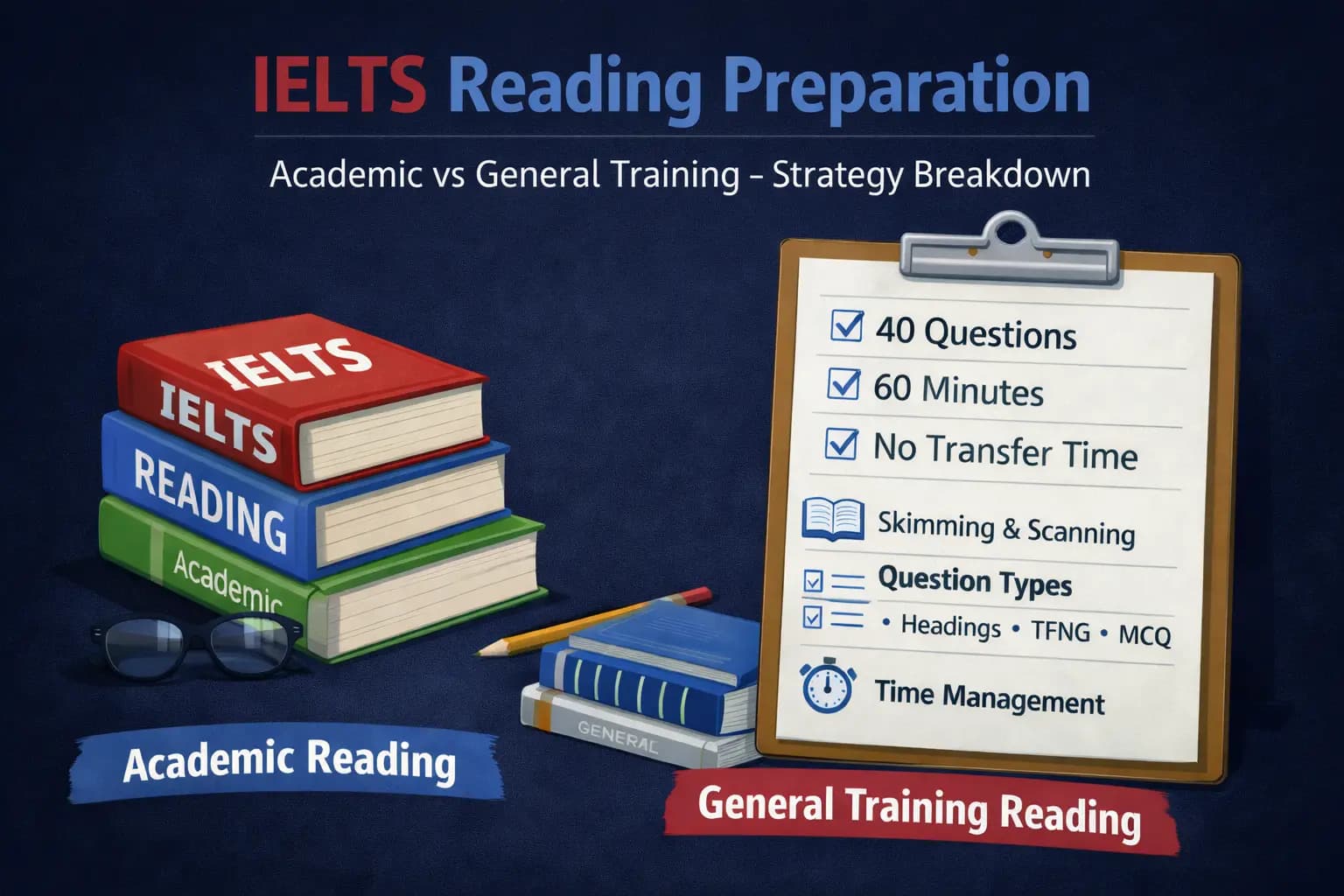
40 questions in 60 minutes, with no extra transfer time.
Summarise blog with AI


How to Prepare for IELTS Academic and General Training Reading

SAM

Reviewed by Fatima Khan
- 5 min read

Last updated on 03 Feb 2026
Summarise blog with AI
You don't fail IELTS Reading because you're "bad at English." You fail because time slips away while the answers hide in plain sight.
Key Takeaways
- Know what each test uses for texts and sections.
- Use strict time rules, move on fast, and return later.
- Practice headings, TFNG, and completion tasks every week.
- Review mistakes with an error log, not guesswork.
- Keep going, set a target band, and commit to it.
Know Your IELTS Reading Test Format (Academic vs General)
IELTS Reading checks if you can catch the main ideas, key details, inference, implied meaning, and the writer's view or opinion. It also tests whether you can follow an argument's flow (practical overview at IELTS IDP).
Both versions have 40 questions in 60 minutes, with no extra time to transfer answers. Common task types include multiple choice, matching headings, matching features, matching sentence endings, sentence completion, summary/note/table/flow-chart completion, and short-answer questions.
Choose your version today and block three practice sessions this week.
IELTS Academic Reading: Why Is It Harder?
In IELTS Academic Reading you get three long texts from books, journals, magazines, and newspapers. The topics are academic in nature, and the language is denser.
Band scores vary by test date, but as a general guide, around 30 correct answers often sit near Band 6, while mid-30s can reach Band 7 (band scale reference at IELTS.org).
Pick two sources (science, history, business) and read for 10 minutes daily.
General Training Reading: The "Easy Texts" That Still Trick You
IELTS General Training Reading has three sections: social survival (notices, advertisements, timetables), workplace survival (job documents, policies, manuals), and one longer general interest text (format details at British Council).
The biggest trap is small details—similar numbers, dates, and conditions. The same 60-minute clock applies, so speed matters. AlfaIELTS helps build time-management habits with timed practice and feedback.
Collect real-life texts such as forms, menus, and policies, and practise reading them fast.
Step-by-Step Strategy to Improve Your IELTS Reading
1
Skim first
Read titles, first lines, and topic sentences.
2
Scan next
Hunt for names, dates, numbers, and key nouns.
3
Read for detail only where needed
Don't read everything.
4
Think in synonyms
Answers rarely repeat exact question words.
5
Use time rules
If stuck, guess, move on, and return later.
6
Never leave blanks
There's no penalty for wrong answers.
Daily Routine
- 5 minutes: skim one short article.
- 10 minutes: scan for names, dates, and numbers.
- 15 minutes: do 10–15 mixed question tasks.
- 5 minutes: review mistakes and note why you missed them.
- 5–10 minutes: learn vocabulary in context.
Set a timer and do your first timed set now. Start today with AlfaIELTS practice tasks and track your score out of 40.
Weekly Routine
Do one full-time test weekly, then review without a dictionary. Build an error log with labels such as time management, keyword match, synonym miss, inference, writer's view, and careless mistakes.
Schedule your next full test on Alfa's AI-scored IELTS mock test and write down your top two weak areas.
How to Handle the Most Common IELTS Reading Question Types Fast
Matching headings, True/False/Not Given, multiple choice, and completion tasks cause the biggest time loss. Always read instructions carefully, respect word limits, and confirm answers using nearby sentences.
Pick your weakest type and practise it for 15 minutes.
Matching Headings and Writer's View Questions (Quick Method)
Read the first and last sentence of each paragraph and match the main idea, not a detail. For writer's view, watch for words like "argues," "suggests," and "criticizes," along with contrast markers such as "however" and "although."
Do one matching headings set and explain each choice in one line.
Completion and Short Answers (Avoid Losing Marks)
If the instruction says "NO MORE THAN TWO WORDS," don't write three. Spelling matters, and grammar must fit the sentence. Scan for the exact location and copy the correct form.
Practice 10 completion questions and double-check every word limit.
Conclusion
Learn the format, practise real question types, build speed with skimming and scanning, take timed tests, and review mistakes with an error log. With the right strategies, you can reach your target band.
Also Read: How to Crack IELTS Exam in First Attempt | Complete Guide
FAQs
Q1. How many questions are in IELTS Reading?
Q2. Is IELTS Reading harder in Academic or General?
Academic usually feels harder because texts are longer and more academic.
Q3. What is the best way to improve IELTS Reading fast?
Timed practice with skimming, scanning, and deep review of mistakes.
Q4. How do I manage time in IELTS Reading?
Move on when stuck, return later, and guess instead of leaving blanks.
Q5. What score do I need for Band 7 in Reading?
It varies, but you often need mid-30s correct answers. IELTS bands range from 0 to 9.
Ready to improve faster with real-time feedback?
Try Alfa's AI-powered platformSAM
Author

Tags:
Share: