
About the IELTS Academic Writing Format
The IELTS Writing test is conducted to assess your ability to write a response to a given condition. It evaluates your capability to think about solutions and draft in a coherent way by using words and grammatical accuracy. This writing section is conducted in 60 minutes, in which candidates are asked to complete two tasks.
In the first, they are required to write a 150-word essay in 20 minutes, and in the second task, they have to finish writing a 250-word essay within 40 minutes. The writing test is scored on a band scale of 0-9, in increments of 0.5, based on specific marking criteria.

Marking Criteria
IELTS writing is marked on four basic assessment criteria. The examiners give you a band score in IELTS writing. Here are the four assessment criteria used for marking
Task Achievement/ Task Response
This refers to effectively addressing all key points and completing the task requirements by elaborating ideas and supporting them with suitable examples.
Cohesion and coherence
This means how well your text is structured. To increase the coherence and cohesion score, you should learn paragraphing. Ensure to get clear ideas from paragraphs. You should use cohesive devices (ex., connectors, pronouns, conjunctions) and linking words.
Lexical resources
This describes how good you are at vocabulary. It is good to use a range of vocabulary to increase the lexical resource score and avoid errors in word formation and spelling.
Grammar accuracy and range
This describes how good your grammar is. To increase the Grammatical Range & Accuracy score, you must use various types of grammatical structures and tenses. It is suggested to avoid sentence errors and manage punctuation.
Your writing essays will be evaluated by 2-4 examiners, and maintain accuracy in your marking. The band score is scaled between 0-9. You can enhance your band score by buildin a cohesive writing vocabulary.
Tasks in IELTS Academic Writing
In the IELTS writing test, there are two tasks given to candidates
Academic Writing - Task 1
What's involved?
In task 1, you should describe visual information. You have to write 150 words within 20 minutes of the task. This task is shorter than task 2, and less contributed to your writing score in IELTS. The visual information you should describe is in the form of tables, graphs, charts, maps and diagrams. For example, you need to write a 150-word report on a given graph and chart that describes participants who play the Olympics this year. In this task, you should give all the necessary details mentioned in the instructions, such as comparisons and main features.
What skills are tested?
It evaluates your skills to identify the important and relevant information from a given table, graph, chart or diagram in a structured manner.
How much do I have to write?
You should write a minimum of 150 words in task 1.

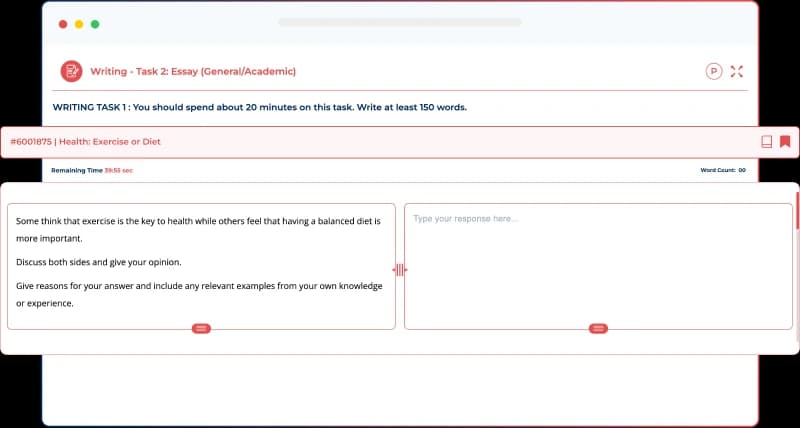
Academic Writing - Task 2
What's involved?
In task 2, you get a problem, argument or point of view. You should write a minimum of 250 words within 40 minutes. It takes longer than Task 1. It is a tougher task than Task 1, because you need to organize your answers in a clear way and give examples to support your ideas in this task. The topic on which you should write 250 words is related to the environment, education, money, business, lifestyle, etc. You should write essays to give solutions to problems, convey your ideas, and present information in a clear way to justify your opinions.
What skills are tested?
It tests your skills to present ideas in the right order, covers all mentioned information in instructions, and connects information while writing. It also evaluates your skills to justify arguments in specific word count with relevant examples.
How much do I have to write?
Minimum of 250 words
Ready to Start
Sign up now and get a free mock test with instant AI scoring and Feedback. No
credit card required


Frequently Asked Questions
How to get 8 bands in IELTS academic writing?
You should practice regularly and be familiar with both tasks to get 8 bands in the writing module. You should always remember to answer all parts of your writing test, focus on building a strong vocabulary, use examples that describe your opinions, follow essay structure, and use the right tenses. It is also suggested to avoid grammatical errors in your writing module, to score well in writing tests.
Why is IELTS academic writing difficult?
The IELTS academic writing is a difficult exam because it is assessed based on 4 marking criteria. The use of grammar, words and task responses are evaluated to score good in your writing module. You can clear this test easily by practicing regularly.
Can I rewrite the IELTS writing test?
If you want to increase your IELTS score, then you can rewrite the writing test.
Can I write over 250 words in Task 2 of writing?
No, you can't write more than 250 words. You should follow the instructions given and stay limited to word count while answering task 2.
How to practice for the IELTS writing test?
You can easily practice for the IELTS writing test by familiarising yourself with task types, use standard study material, practice by online preparatory tests to enhance your performance. It is also recommended to learn uncommon words and build vocabulary.
