
About IELTS Academic Test
The IELTS academic test aims to evaluate the knowledge of candidates who apply for higher studies or professional certifications abroad. This test evaluates your knowledge to determine whether you are ready to start studying or training in the English language abroad or not. The UK, US, Canada, Australia, and New Zealand are some of the countries that accept IELTS academic scores. The purpose of why IELTS Academic test is conducted is
- to study abroad at the UG or PG level in an English-speaking country
- to apply for a Student Route visa (Tier 4) to study in a UK University
- To work for a professional organization in an English-speaking country
IELTS Academic Test Structure
There are four sections in the IELTS Academic test: listening, reading, writing, and speaking. Let us break down all sections below with their descriptions.
| Sub-section | Duration | Questions |
|---|---|---|
| Listening | 30 minutes |
|
| Speaking | 11–14 minutes |
|
| Reading | 60 minutes |
|
| Writing | 60 minutes |
|
IELTS Academic Test Structure
The IELTS General Test format for every section is given below
Listening
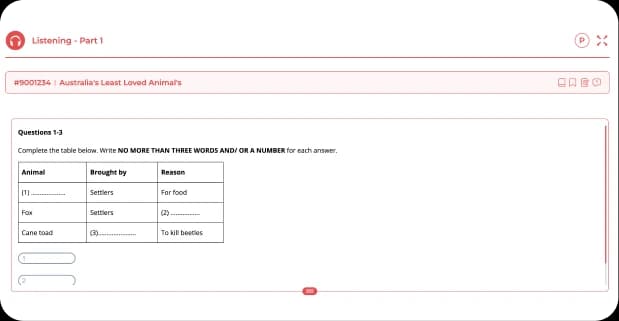
You get four recordings in the listening module, and you need to answer based on the basis of recordings. You should finish listening in 30 minutes. You can listen to one recording at once. In the first Recording, you hear a conversation about daily life. In the second Recording, you hear speech about daily life or social issues, like talking about your society.
In the third Recording, you should respond to a discussion among two or more people on the educational context. In the fourth Recording, you listen a speech on educational topics, like a lecture given at college.

Reading
In the reading module, you get 40 questions to answer in 60 minutes. This test is designed to evaluate your reading skills. Candidates need to read texts from journals, books, newspapers, magazines, etc, and express their opinions. The reading test is divided into three sections, and the total text length is 2150–2750 words. The passages in reading tests reflect topics related to the professional and academic environment in English-speaking countries.
Writing
The IELTS academic writing test consists of two tasks on general topics. In task 1, you should write a report based on information from the table, a chart, a graph, a map, or a structural drawing. You should summarize the text in 150 words in Task 1. In task 2, you should give a point of view, argument, or problem that needs to be discussed in 250 words.


Speaking
The IELTS academic speaking duration is 11-14 minutes. It consists of a face-to-face interview with the examiner and is divided into 3 parts. The three parts in the speaking module are the introduction and interview, the long turn, and the discussion. The speaking module assesses your skills to communicate in English.
In speaking part 1, you will be asked a few questions about yourself, your family and friends, your goals, interests, and studies. In speaking part 2, you are talking about a specific topic after getting the card. You get 1 minute to prepare for the topic, and you should speak for 2 minutes on the topic. In speaking part 3, your examiner questions you about things that are connected to the topic in Part 2.
Ready to Start
Sign up now and get a free mock test with instant AI scoring and Feedback. No
credit card required


Frequently Asked Questions
What is the IELTS academic test?
The academic IELTS test is an English language proficiency test. It is for those who want to pursue higher studies or seek professional registration in an English-speaking environment.
Is Academic IELTS tough?
Yes, IELTS academics are tougher than general training IELTS. The academic module is conducted to assess the academic language and skills of individuals.
What are the 4 skills in the IELTS test?
The four required skills in IELTS tests are listening, reading, writing, and speaking. These skills are evaluated in tests to measure the proficiency of candidates in the English language.
Who needs the IELTS academic exam?
The IELTS academic test is conducted for individuals who apply for higher courses at universities abroad, where English is the core medium of instruction. The professionals who want to be registered or licensed in an English-speaking country, as doctors, engineers, or nurses, also need to crack the IELTS academic test.
What is a good score to achieve in the IELTS academic test?
The good score you achieve in the IELTS academic test varies by purpose and institute. The score range between 6.5 to 7.0 is good and acceptable for admissions in top universities. A high score of 7.5 or above is also required for competitive programs.
